S139 Core Booster Motor Segments (PSLV / GSLV Mk II)
 Walchandnagar Industries
First-stage core booster motor casing segments (S139) manufactured for ISRO's PSLV and GSLV Mk II first stage.
Technical specifications
- Application
- Core (first-stage) booster motor casing segment, PSLV / GSLV Mk II
- ISRO designation
- S139
- Units delivered to date
- 134
- Programme heritage
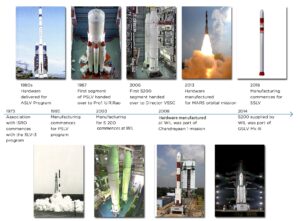
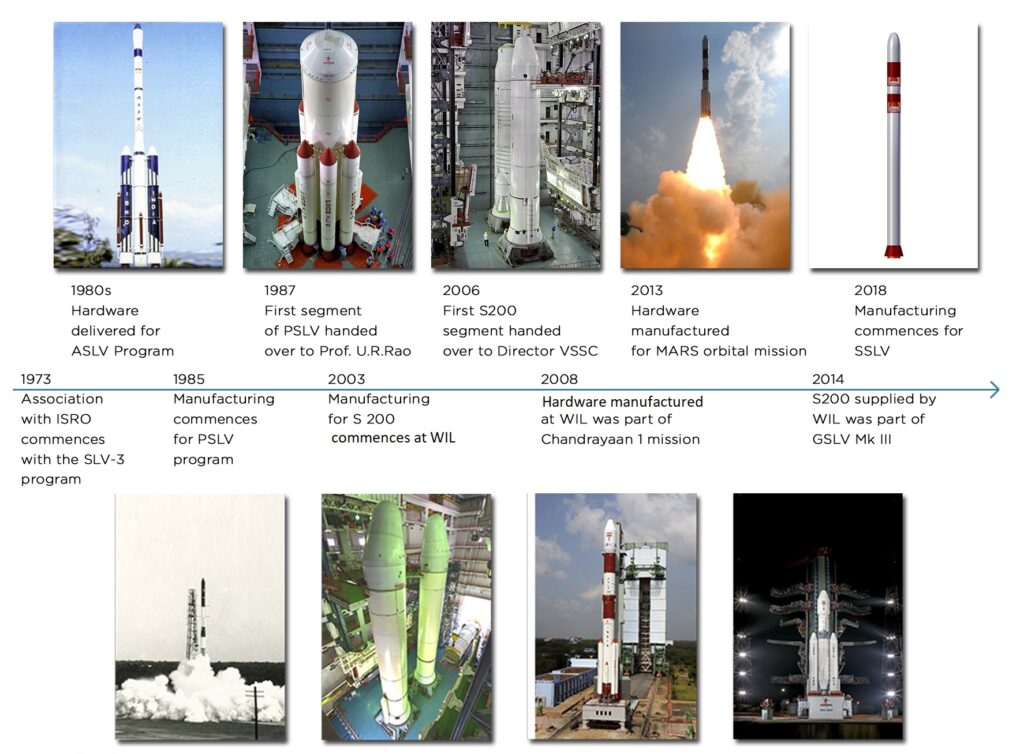
- Manufacturing commenced 1985; first segment delivered 1987
- Materials
- 15CDV6 alloy steel, high-strength maraging steel
- Manufacturing processes
- Metal forming, metal joining, heat treatment, fabrication, precision machining, pressure testing
- Delivery cadence (2019-20/2020-21 forecast)
- ~1 S139 end-segment set per month (per ISRO/VSSC correspondence)
- Customer
- Indian Space Research Organisation (ISRO) / Vikram Sarabhai Space Centre
About
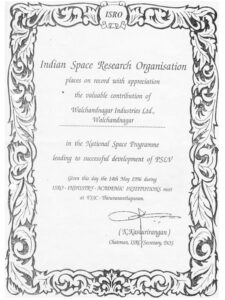
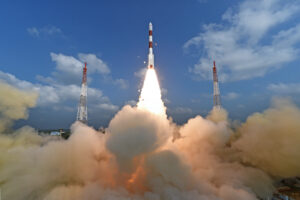
The S139 is the solid-propellant core (first-stage) booster motor casing used on ISRO’s PSLV and GSLV Mk II launch vehicles. Walchandnagar Industries (WIL) began manufacturing for the PSLV programme in 1985, and the first PSLV core segment was formally handed over to Prof. U. R. Rao in 1987; series production of these segments has been running at WIL ever since. To date WIL has supplied 134 core booster units for the PSLV/GSLV Mk II programme, alongside the strap-on boosters and other rocket motor hardware built for the same vehicle family. A 2018 letter from ISRO’s Vikram Sarabhai Space Centre to WIL’s management explicitly references forthcoming launch-cadence requirements for ‘S139/S200/PS0M-XL motor cases,’ including a need for roughly one S139 end-segment set per month, confirming S139 as the core booster motor case designation used by ISRO for this hardware. The segments are fabricated from aerospace-grade high-strength steel using metal forming, joining, heat treatment, fabrication, precision machining and pressure-testing processes qualified for large, complex-geometry pressure vessels, and have supported launches of ROHINI, SROSS, IRS and G-SAT satellites as well as the Chandrayaan-1 and Mangalyaan missions.
Documentation
No public datasheet yet — request the datasheet / ICD from the supplier.