Umbra S-Band Radio
 Umbra Lab Inc.
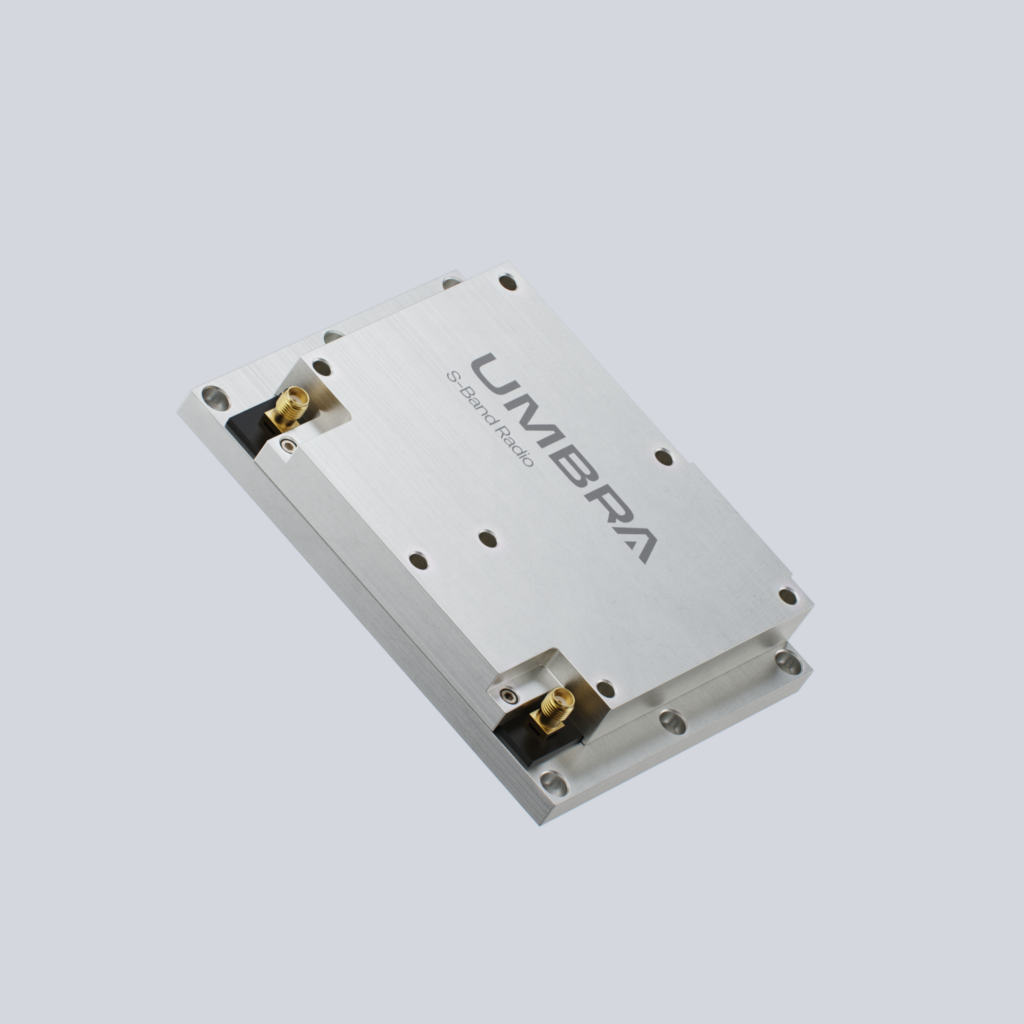
Space-qualified Unified S-Band transceiver for command and telemetry, remotely configurable on-orbit, with 2 W output power.
Technical specifications
- Max Dimensions
- 4.82 in x 3.7 in x 0.812 in
- Mass
- < 300 g
- Bus Voltage Range
- 28 ± 4 V
- Bus Voltage Nominal
- 28 V
- Peak Power
- 15.7 W while transmitting
- Average Power
- 4.4 W while receiving
- Electrical Interface
- 15-Pin Micro-D Connector
- Data Interface
- GigE over IX connector with serial backup
- Output Power
- Up to 2 W
- Data Rate
- 1 kbps to 1 Mbps
- Operating Doppler
- ± 100 kHz at 10 kHz/s
- Sensitivity @ 100 kbps
- -100 dBm
- Transmit MODCOD
- OQPSK, HDLC, NRZ-L/M/S, Convolutional Encoding (k=7, 1/2, G2 inverted), Reed-Solomon (255,223)
- Receive MODCOD
- BPSK, HDLC, NRZ-L/M/S
- Frequency Range
- Uplink: 2025-2110 MHz; Downlink: 2200-2290 MHz
- Acquisition Time
- < 3 seconds
- Intended Space Environment
- LEO
- Heritage
- Acceptance tested. First flight Q2 2026
- Design Life
- 5+ Years
- Production
- Assembled and tested in the USA
- Random Vibe
- Qualified to 14.16 Grms profile enveloping GEVS, Falcon 9, SpaceX Rideshare, and Electron levels
- Shock
- Qualified to 1000g peak profile
- Operating Temperature
- -30°C to 65°C
- Survival Temperature
- -40°C to 85°C
- EMI/EMC
- MIL-STD-461
- Total Ionizing Dose
- Designed to withstand at least 30 krad TID
About
The Umbra S-Band Radio is a qualified transceiver for command and telemetry in Low Earth Orbit. It supports Unified S-Band, complies with CCSDS modulation and coding standards, and integrates via an industrial Ethernet interface. With testing tailored for Falcon 9 rideshare missions, it offers post-launch reconfigurability, reliable communication with commercial ground stations, and up to 2 W of output power to close demanding link budgets, built on Umbra’s own TT&C operational experience.
Documentation
Need the full ICD, test reports or a specific revision? Ask the supplier directly.