μDragonfly Bus
 Dragonfly Aerospace
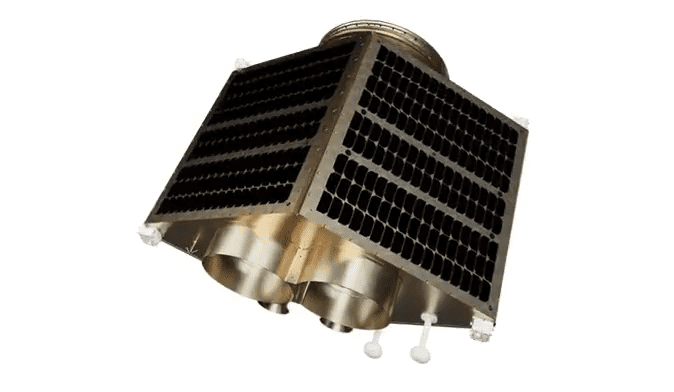
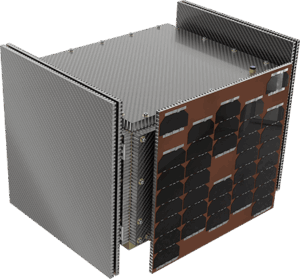
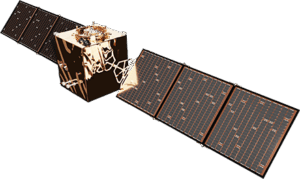
100 kg-class microsatellite platform optimised for very-high-resolution Earth observation, flight-proven on EOSSAT-1.
Technical specifications
- Class
- 100 kg bus
- Lifetime
- 5 years
- Energy Storage
- up to 600 Wh
- Pointing Control Stability
- < 0.0015°/sec (3-sigma)
- Pointing Control Accuracy
- < 0.01° (3-sigma)
- Slew Rate
- up to 4°/sec
- Geolocation Knowledge Accuracy
- 120 m (3-sigma)
- Control Frequency
- 10 Hz
- AOCS
- Fully automated, through target tracking
- Propulsion
- Xenon Electric Propulsion System, 11mN thrust, 1400s Isp
- S-Band TMTC
- 400 kbps down, 150 kbps up
- X-Band Data Downlink
- 2.5 Gbps
- Solar Array Peak Power
- 220 W
- Orbit Average Power (OAP)
- 140 W
- Peak Power
- 1.2 kW
- Bus Voltage
- 24.3-32.4 V (unregulated)
- Available Payload Mass
- up to 70 kg
- Available Payload Volume
- ⌀ 500 mm x 1000+ mm
- Available Payload OAP
- up to 210 W
- Electrical Interfaces (TMTC)
- CANbus, RS422/RS485
- Electrical Interfaces (Data)
- LVDS / SpaceWire / SerDes, Optional HSDR 8 TB (Scalable)
- High-Speed Data Recorder (HSDR)
- 32 GB (EDAC Protected)
About
The μDragonfly Bus is a compact, flight-proven microsatellite platform designed for Earth observation missions requiring a very high level of stability. At just over 100 kg, it offers a robust platform that supports high-performance payloads while maintaining a modular design, making it well-suited for scalable satellite constellations. With EOSSAT-1 as its first mission, the μDragonfly Bus supports demanding remote sensing applications with robust power systems, precise attitude control, a high degree of agility and an architecture optimised for rapid integration and responsive operations. Built to balance performance, reliability, and cost-efficiency, the μDragonfly Bus is ideal for operators seeking proven, scalable solutions that reduce time to orbit without compromising mission success.
Documentation
No public datasheet yet — request the datasheet / ICD from the supplier.