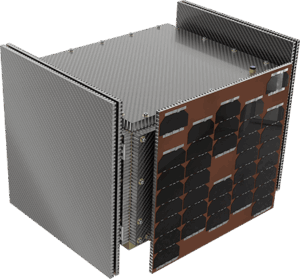
Dragonfly Bus
 Dragonfly Aerospace
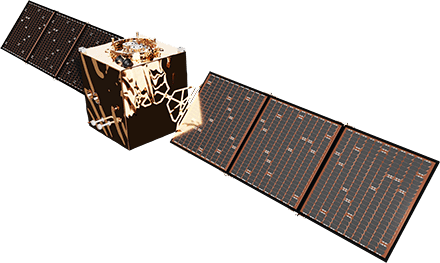
150 kg-class satellite platform for larger, power- and data-intensive Earth observation and SAR missions.
Technical specifications
- Class
- 150 kg (up to 400 kg combined bus and payload)
- Lifetime
- 8 years
- Energy Storage
- up to 2400 Wh
- Pointing Control Stability
- < 0.002°/sec (3-sigma)
- Pointing Control Accuracy
- < 0.02° (3-sigma)
- Slew Rate
- up to 2.5°/sec
- Control Frequency
- 10 Hz
- AOCS
- Fully automated, through target tracking
- Propulsion
- Xenon Electric Propulsion System, 28 mN thrust, up to 1850s Isp
- S-Band TMTC
- 400 kbps down, 150 kbps up
- X-Band Data Downlink
- up to 2.6 Gbps
- Solar Array Peak Power
- up to 1500 W
- Orbit Average Power (OAP)
- up to 800 W
- Peak Power
- 4.2 kW
- Bus Voltage
- 28 V / 48 V (ready)
- Available Payload Mass
- up to 250 kg
- Available Payload Peak Power
- up to 4.0 kW
- Electrical Interfaces (TMTC)
- CANbus, RS422/RS485, GigE
- Electrical Interfaces (Data)
- LVDS / SpaceWire / SerDes / GigE, Optional HSDR 8 TB (Scalable)
About
The Dragonfly Bus is Dragonfly Aerospace’s largest satellite platform, engineered to support more complex, power-intensive and data-intensive payloads. With a combined bus and payload mass of up to 400 kg, it offers increased continuous power delivery, volume, and system redundancy — ideal for missions requiring high data throughput, extended operational lifespans, or more power-intensive payloads such as Synthetic Aperture Radar (SAR). The bus is built with a modular design, enabling custom configurations and streamlined integration for commercial and institutional missions alike, delivering mission versatility, robust performance, and future-ready scalability.
Documentation
No public datasheet yet — request the datasheet / ICD from the supplier.