ηDragonfly Bus
 Dragonfly Aerospace
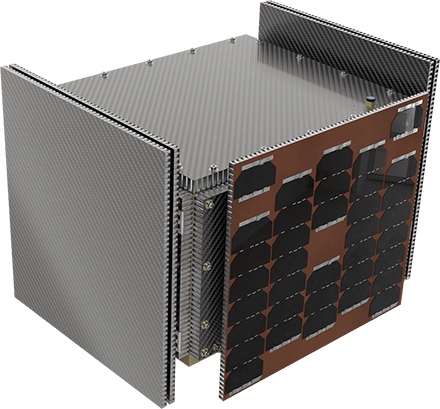
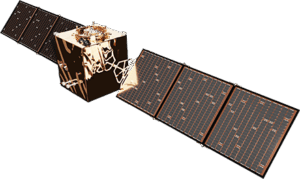
50 kg nano-class satellite bus leveraging EOSSAT-1 avionics heritage, deployable multiple-per-launch.
Technical specifications
- Class
- 50 kg bus, 15" port
- Lifetime
- 5 years
- Energy Storage
- up to 300 Wh
- Pointing Control Stability
- <0.005°/sec (3-sigma)
- Pointing Control Accuracy
- <0.01° (3-sigma)
- Slew Rate
- up to 12°/sec
- Geolocation Knowledge Accuracy
- 120 m (3-sigma)
- Control Frequency
- 10 Hz
- AOCS
- Fully automated, through target tracking
- Propulsion
- Xenon Electric Propulsion System, 11mN thrust, up to 1400s Isp
- S-Band TMTC
- 400 kbps down, 150 kbps up
- X-Band Data Downlink
- 2.6 Gbps (peak)
- Solar Array Peak Power
- 113-197 W
- Orbit Average Power (OAP)
- 71-125 W
- Peak Power
- 1.2 kW
- Bus Voltage
- 24.3-32.4 V (unregulated)
- Available Payload Mass
- up to 50 kg
- Available Payload Volume
- 450 x 450 x 400 mm
- Available Payload OAP
- 20-70 W
- Electrical Interfaces (TMTC)
- CANbus, RS422/RS485, GigE
- Electrical Interfaces (Data)
- LVDS / SpaceWire / SerDes, Optional HSDR 1 TB
About
The cutting-edge ηDragonfly is a nano-class satellite that revolutionises space delivery with the capability to deploy multiple satellites in a single launch. The ηDragonfly combines microsatellite performance and reliability within compact cubesat-class parameters, eliminating the need for additional launcher pods. Weighing just 50 kg, ηDragonfly is engineered to deliver five years or more of in-orbit operation and is designed for sensitive imaging payloads. Leveraging validated avionics components from the successful EOS SAT-1 satellite mission launched in January 2023, ηDragonfly ensures top-tier performance and reliability.
Documentation
No public datasheet yet — request the datasheet / ICD from the supplier.