Quantum Time Transfer (QTT) System
 Xairos
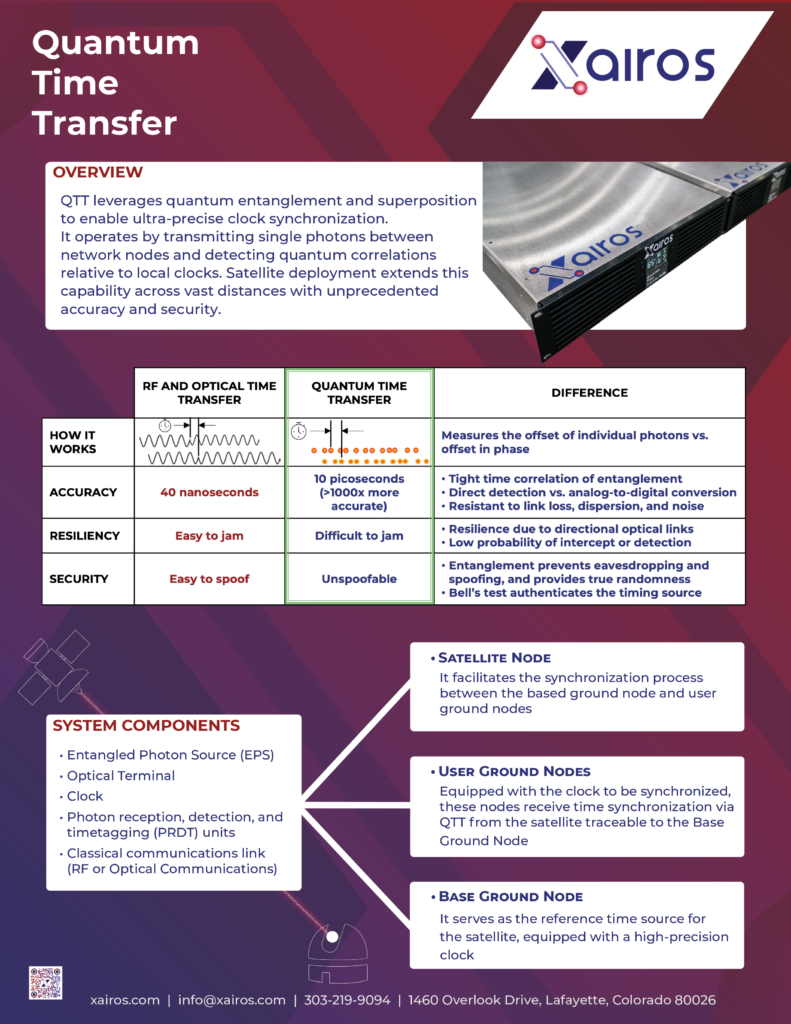
Satellite-based quantum clock synchronization system delivering sub-nanosecond (10-picosecond-class) timing accuracy that is difficult to jam and unspoofable, as a resilient alternative/complement to GNSS timing.
Technical specifications
- How it works (RF/Optical)
- Measures the offset of individual photons vs. offset in phase
- How it works (QTT)
- Tight time correlation of entanglement; direct detection vs. analog-to-digital conversion
- Accuracy (RF/Optical)
- 40 nanoseconds
- Accuracy (QTT)
- 10 picoseconds (>1000x more accurate)
- Resiliency (RF/Optical)
- Easy to jam
- Resiliency (QTT)
- Difficult to jam; resistant to link loss, dispersion, and noise
- Security (RF/Optical)
- Easy to spoof
- Security (QTT)
- Unspoofable; entanglement prevents eavesdropping and spoofing and provides true randomness; Bell's test authenticates the timing source
- System components
- Entangled Photon Source (EPS); Optical Terminal; Clock; Photon reception, detection, and timestamping (PRDT) units; Classical communications link (RF or Optical Communications)
- Satellite Node
- Facilitates the synchronization process between the Base Ground Node and User Ground Nodes
- User Ground Node
- Equipped with the clock to be synchronized; receives time synchronization via QTT from the satellite, traceable to the Base Ground Node
- Base Ground Node
- Serves as the reference time source for the satellite, equipped with a high-precision clock
About
The Quantum Time Transfer (QTT) System is Xairos’s core architecture for quantum-secure global timing. QTT leverages quantum entanglement and superposition to enable ultra-precise clock synchronization: it operates by transmitting single photons between network nodes and detecting quantum correlations relative to local clocks. Satellite deployment extends this capability across vast distances with unprecedented accuracy and security. Unlike conventional RF and optical time-transfer, which measures the offset of individual photons versus a phase offset and achieves roughly 40 nanoseconds of accuracy, QTT achieves approximately 10 picoseconds of accuracy (over 1000x more accurate), is difficult to jam due to its directional optical link and low probability of intercept/detection, and is unspoofable because entanglement prevents eavesdropping and spoofing while providing true randomness (Bell’s-test-authenticated timing source). The system architecture is composed of three main components: an Entangled Photon Source (EPS), an optical terminal, precision clocks, and Photon Reception, Detection, and Timestamping (PRDT) units, tied together with a classical (RF or optical) communications link. In operation, a Satellite Node facilitates the synchronization process between a Base Ground Node and User Ground Nodes; the Base Ground Node serves as the reference time source for the satellite and is equipped with a high-precision clock; and User Ground Nodes, equipped with the clock to be synchronized, receive time synchronization traceable to the Base Ground Node via the satellite. QTT is aimed at applications requiring resilient, secure, high-accuracy timing such as telecommunications networks, financial transaction systems, data centers, power grids, and transportation systems that are currently vulnerable to GNSS jamming and spoofing.
Documentation
No public datasheet yet — request the datasheet / ICD from the supplier.