ARES-A1 Free-Space Terminal
 Xairos
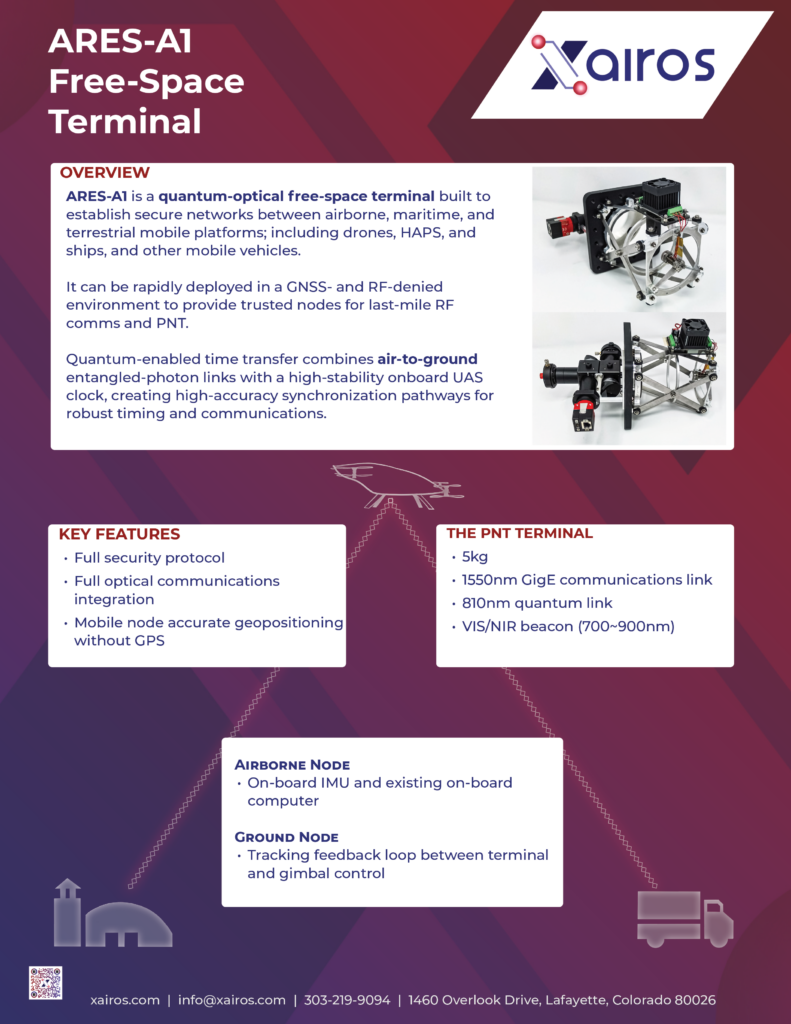
Quantum-optical free-space communications and PNT terminal for rapid deployment on drones, HAPS, ships, and other mobile platforms in GNSS- and RF-denied environments.
Technical specifications
- Overview
- Quantum-optical free-space terminal for secure networks between airborne, maritime, and terrestrial mobile platforms (drones, HAPS, ships, other mobile vehicles)
- Deployment environment
- Rapidly deployed in GNSS- and RF-denied environments to provide trusted nodes for last-mile RF comms and PNT
- Timing capability
- Quantum-enabled time transfer combines air-to-ground entangled-photon links with a high-stability onboard UAS clock for high-accuracy synchronization pathways for timing and communications
- Key features
- Full security protocol; Full optical communications integration; Mobile node accurate geopositioning without GPS
- Mass
- 5 kg
- Communications link
- 1550 nm GigE communications link
- Quantum link
- 810 nm
- Beacon
- VIS/NIR beacon (700-900 nm)
- Airborne Node
- On-board IMU and existing on-board computer
- Ground Node
- Tracking feedback loop between terminal and gimbal control
About
ARES-A1 is a quantum-optical free-space terminal built to establish secure networks between airborne, maritime, and terrestrial mobile platforms, including drones, High-Altitude Pseudo-Satellites (HAPS), ships, and other mobile vehicles. It can be rapidly deployed in GNSS- and RF-denied environments to provide trusted nodes for last-mile RF communications and Position, Navigation, and Timing (PNT). Quantum-enabled time transfer combines air-to-ground entangled-photon links with a high-stability onboard UAS clock, creating high-accuracy synchronization pathways for robust timing and communications. Key features include a full security protocol, full optical communications integration, and mobile-node accurate geopositioning without GPS. The PNT terminal weighs approximately 5 kg and integrates a 1550 nm GigE communications link, an 810 nm quantum link, and a VIS/NIR beacon (700-900 nm). The airborne node integrates with the platform’s on-board IMU and existing on-board computer, while the ground node implements a tracking feedback loop between the terminal and gimbal control to maintain pointing during dynamic operations.
Documentation
No public datasheet yet — request the datasheet / ICD from the supplier.