OLYMPUS ClockSynQ-Sim
 Xairos
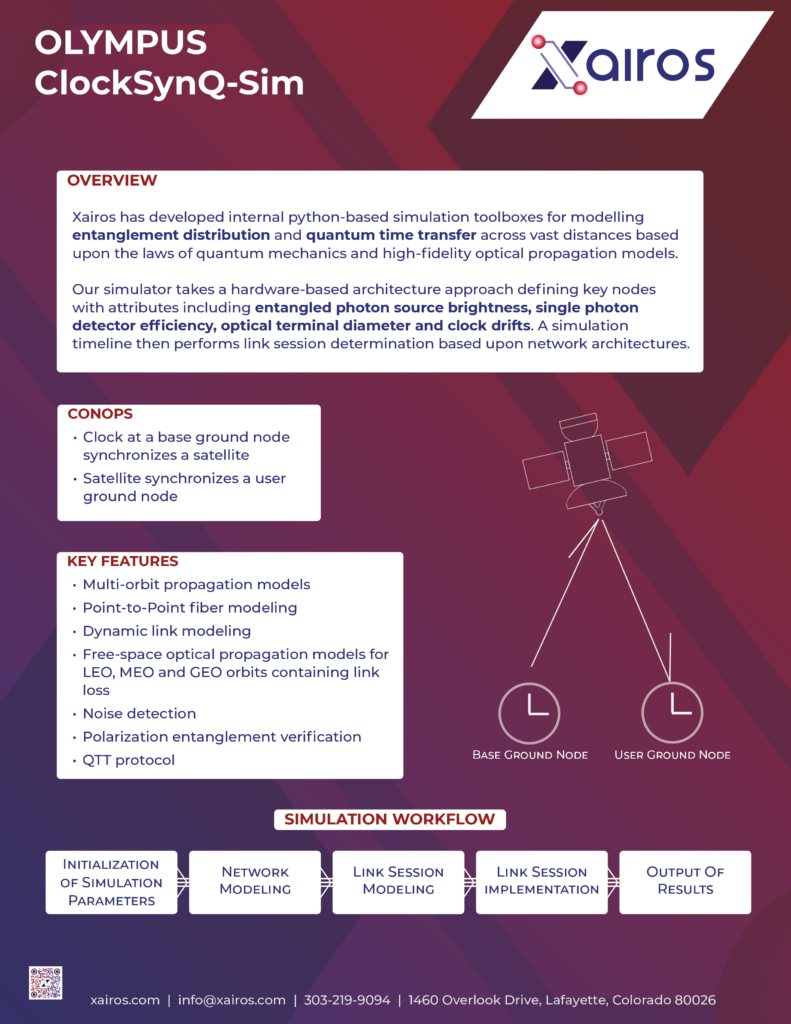
Internal Python-based simulation toolbox for modeling entanglement distribution and quantum time transfer performance across satellite, fiber, and free-space network architectures.
Technical specifications
- Type
- Internal Python-based simulation toolbox
- Models
- Entanglement distribution and quantum time transfer across vast distances based on quantum mechanics and high-fidelity optical propagation models
- Architecture attributes modeled
- Entangled photon source brightness; single photon detector efficiency; optical terminal diameter; clock drifts
- Concepts modeled
- Clock at a base ground node synchronizes a satellite; satellite synchronizes a user ground node
- Key features
- Multi-orbit propagation models; Point-to-Point fiber modeling; Dynamic link modeling; Free-space optical propagation models for LEO, MEO and GEO orbits containing link loss; Noise detection; Polarization entanglement verification; QTT protocol
- Simulation workflow
- Initialization of Simulation Parameters -> Network Modeling -> Link Session Modeling -> Link Session Implementation -> Output of Results
About
OLYMPUS ClockSynQ-Sim is a Python-based simulation toolbox developed by Xairos for modeling entanglement distribution and quantum time transfer (QTT) across vast distances, grounded in the laws of quantum mechanics and high-fidelity optical propagation models. The simulator takes a hardware-based architecture approach, defining key network nodes with configurable attributes including entangled photon source brightness, single photon detector efficiency, optical terminal diameter, and clock drift, then runs a simulation timeline that performs link session determination based on the modeled network architecture. Core concepts modeled include a clock at a base ground node synchronizing a satellite, and a satellite in turn synchronizing a user ground node. Key features include multi-orbit propagation models, point-to-point fiber link modeling, dynamic link modeling, free-space optical propagation models for LEO, MEO, and GEO orbits (including link loss), noise detection, polarization entanglement verification, and full modeling of the QTT protocol. The simulation workflow proceeds through five stages: initialization of simulation parameters, network modeling, link session modeling, link session implementation, and output of results. ClockSynQ-Sim is used internally by Xairos to design, validate, and optimize QTT network architectures (satellite, fiber, and free-space) prior to hardware deployment.
Documentation
No public datasheet yet — request the datasheet / ICD from the supplier.