Kepler Network
 Kepler Communications
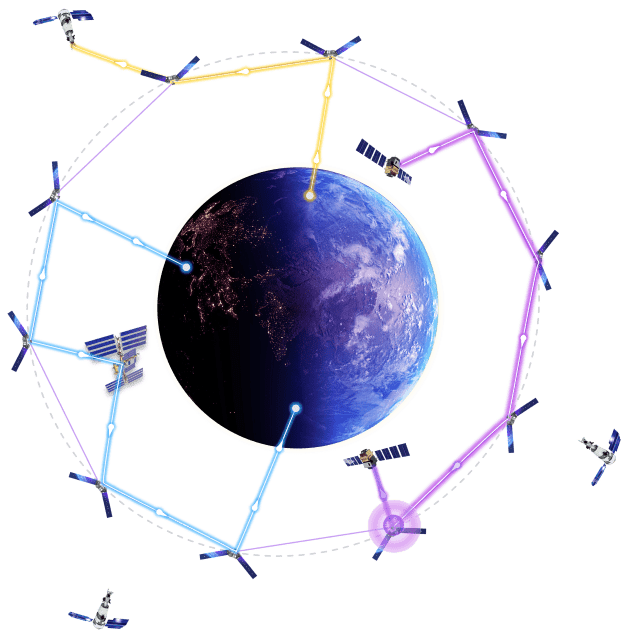
Optical data-relay constellation providing always-available, real-time connectivity and on-orbit compute for LEO missions.
Technical specifications
- Flight heritage
- 33 satellites launched to date
- Spacecraft class
- ~300 kg-class hosting spacecraft
- Payload power
- Hundreds of watts available for hosted payloads
- Deployment cadence
- ~10 satellites every 2 years (next tranche T2 in 2028)
- Services
- Real-time optical connectivity, on-orbit edge compute (Kepler Compute), hosted payload (Kepler Hosted)
About
The Kepler Network is Kepler Communications’ optically interconnected satellite constellation, designed to act as an always-connected cloud environment on orbit. It provides customers with on-demand, real-time connectivity in low Earth orbit, eliminating the ground-pass bottlenecks of traditional communications architectures and enabling continuous, high-rate data transmission and live-streaming of mission data. The network also underpins Kepler Compute, an on-orbit edge-processing service that brings advanced data processing closer to the source for faster, more autonomous decision-making, and Kepler Hosted, a hosted-payload service that places customer payloads directly onto the Kepler Network’s optically linked spacecraft. Hosted missions fly on 300 kg-class spacecraft with hundreds of watts of available payload power, accommodating payloads from CubeSat-scale to small-satellite-class systems, and are priced based on payload size, power, and integration complexity. With nearly a decade of on-orbit heritage, Kepler has launched 33 satellites to date and plans to deploy a new tranche of roughly ten satellites every two years, with the next tranche (T2) scheduled for 2028.
Documentation
Need the full ICD, test reports or a specific revision? Ask the supplier directly.