KepNet LEO Connectivity Network
 Kepler Communications
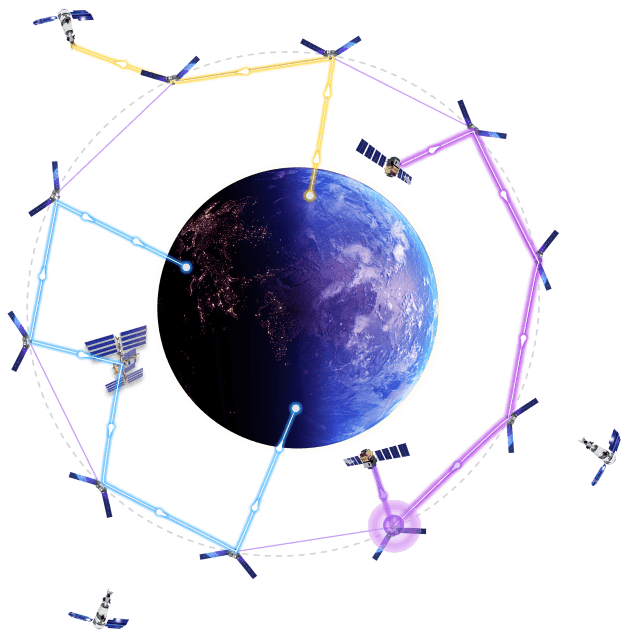
Low-latency LEO satellite broadband connectivity service for maritime, aviation, and remote industrial sites — real-time data relay and IoT sensor connectivity from growing constellation.
Technical specifications
- Orbit
- LEO (~550 km)
- Latency
- <50 ms round-trip (LEO advantage)
- Service Type
- Broadband, real-time data relay, IoT
- Coverage
- Global including high-latitude regions
- Markets
- Maritime, aviation, remote industrial, oil & gas
- Integration
- Terrestrial IP network compatible
About
KepNet is Kepler Communications’ satellite connectivity service, providing low-latency broadband and real-time data relay from a growing constellation of LEO microsatellites. The service targets customers in maritime, aviation, energy, and remote industrial sectors where terrestrial broadband is unavailable and GEO satellite internet introduces unacceptable latency for operational applications.
The KepNet architecture leverages LEO altitude advantages — approximately 550 km compared to GEO’s 36,000 km — to deliver round-trip latencies below 50 ms for interactive applications and real-time operational data. The service supports vessel tracking, remote field operations, satellite-to-satellite data relay, and IoT sensor connectivity from offshore platforms, remote mining operations, pipeline monitoring, and mobile platforms that move beyond cellular coverage.
Kepler’s KIPP-series microsatellites provide the network nodes, with onboard processing capable of routing and prioritizing traffic before retransmission. The company is expanding its constellation to improve coverage density and revisit time, working toward continuous real-time connectivity over high-latitude and polar regions that are underserved by GEO systems. KepNet is designed to integrate with terrestrial IP networks, enabling seamless handoff as assets move in and out of cellular coverage.
Documentation
No public datasheet yet — request the datasheet / ICD from the supplier.