ESAT Training Nanosatellite
 Theia Space
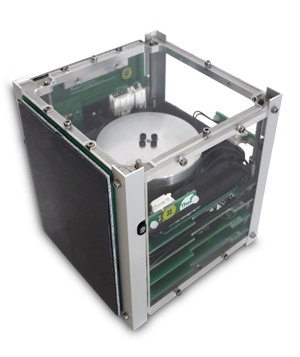
10x10x10 cm CubeSat-standard training nanosatellite with full electrical power, ADCS, OBC, structure and Wi-Fi communications subsystems, plus ground segment software, for hands-on space engineering education.
Technical specifications
- Form factor
- 10 x 10 x 10 cm (CubeSat standard)
- Mass
- < 1 kg
- Communications
- Wi-Fi link to PC; full-duplex simultaneous TM/TC
- Modulation
- OOK, binary and quaternary FSK, GFSK
- RF frequency
- Designed for 435-525 MHz band; supports 0.14-1 GHz range
- Antennas
- Detachable; standalone and integrated modes supported
- Electrical Power Subsystem
- Two solar panels; main board with MPPT regulator and programmable processor; secondary board with two batteries and DET regulator; two power switches; current, voltage and temperature sensors
- EPS autonomy
- More than 3 hours
- ADCS sensors/actuators
- Magnetometer, two magnetorquers, momentum wheel with tachometer, four sun sensors; user-programmable control laws
- Command and Data Handling
- Programmable processor, micro SD card storage, USB debug communication
- Ground segment
- ESAT GUI with real-time telemetry monitoring/plots, telecommand parameter fields, multi-ESAT classroom configurations; ground station included
- Thermal payload (optional)
- GPIO-controllable heater element, thermistor, controllable LEDs
- Ground Support Equipment (optional)
- Magnetic field simulator, sun simulator, turntable, assembly tools
- Workstation OS
- Windows 7 or above (Windows 10 recommended); ground segment SW also compatible with macOS Mavericks+, CentOS Linux 6.5/6.6/7, Ubuntu 14.04 LTS (unsupported)
About
ESAT is a fully functional 10x10x10 cm, CubeSat-standard training nanosatellite developed by Theia Space for hands-on space engineering education at all levels, from STEM outreach in schools to university coursework and professional training in industry. Weighing less than 1 kg, ESAT integrates realistic Electrical Power, Attitude Determination and Control, Command and Data Handling, Structure and Communications subsystems, so students can operate the fully integrated satellite or work on each subsystem independently.
ESAT communicates with a PC over Wi-Fi using its own ESAT Graphical User Interface for real-time telemetry monitoring/plotting and telecommand, and it ships with a dedicated ground station. The platform is designed to be extended: subsystem interfaces and open-source ESAT code are provided so users can integrate and test their own hardware and software developments. Optional Ground Support Equipment (magnetic field simulator, sun simulator, turntable, assembly tools) and a GPIO-controllable thermal payload are available for extended training exercises.
ESAT has been selected by ESA Academy for hands-on space-engineering training programmes and is used by universities and institutions worldwide to teach realistic satellite design, integration, validation and operation.
Documentation
- THEIA-CI-ESAT001-i1-r0.pdf www.theia.eusoc.upm.es ↗
- ESAT-BROCHURE_LOW_RESOLUTION-i1-r1.pdf www.theia.eusoc.upm.es ↗
Need the full ICD, test reports or a specific revision? Ask the supplier directly.