LizzieSat
 Sidus Space, Inc.
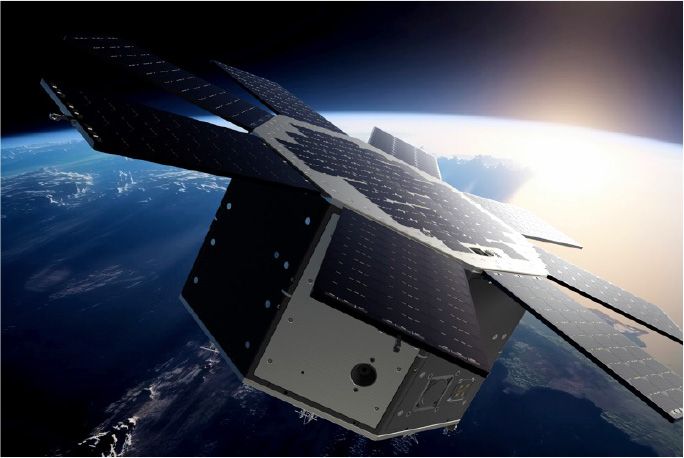
Flight-proven, hybrid composite/3D-printed multi-mission microsatellite bus for Earth observation, technology demonstration, and microgravity research.
Technical specifications
- Class
- Microsatellite
- Mass
- 100 kg
- Shape
- Octagonal prism
- Volume
- 11,500 in3 (188U)
- Available payload mass
- 35 kg (without propulsion), 20 kg (with propulsion)
- Available payload volume
- 27U (without propulsion), 18U (with propulsion)
- Altitude
- 300-650 km
- Inclinations
- 30.0, 45.0, 51.6, 63.4, 92.0, 98.6 degrees
- Orbital period
- 90.4-97.6 min
- TT&C downlink
- S-band, 2200-2300 MHz, 2 Mbps, up to 30 dBm, CCSDS 131.0-B
- TT&C uplink
- S-band, 2025-2120 MHz, 256 kbps, CCSDS 231.0-B-3
- Payload downlink
- X-band, 8.025-8.4 GHz, 150 Mbps, 27-33 dBm, DVB-S2
- Battery
- Lithium ion, 1100 Wh (two 550 Wh assemblies), 24.0-33.6V
- ADCS
- 3-axis control, 0.01 degree mean accuracy and pointing knowledge (3 sigma)
- Solar power
- 400W, 8 deployable panels, triple junction GaInP/GaAs/Ge on Ge substrate
- Optional propulsion
- Bi-propellant 1N thruster, N2O + C3H6, 11.5 kNs total impulse, 1115 m/s total delta-v
- Flight heritage
- LS-1 (Transporter-10, Mar 2024), LS-2 (Bandwagon-2, Dec 2024), LS-3 (Transporter-13, Mar 2025)
About
LizzieSat is a highly adaptable, software-defined satellite bus platform supporting Earth observation, in-orbit demonstrations, technology validation, and microgravity and radiation research, at technology readiness level 9 with flight heritage across three launched units: LS-1, LS-2, and LS-3. The platform is designed for 3, 5, or 7-year mission life with simultaneous multi-sensor data collection, including multispectral, AIS, and optical, and near-real-time AI edge processing via the Orlaith ecosystem.
Documentation
No public datasheet yet — request the datasheet / ICD from the supplier.