Ka-Band Integrated Transceiver Module UDC400
Arralis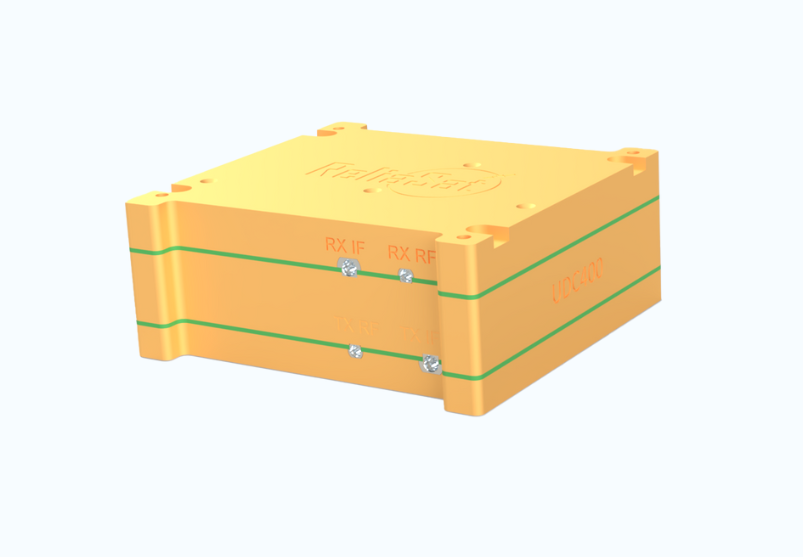
The UDC400 is a compact standalone Ka-band transceiver module for LEO satellite communications, offering 250 MHz instantaneous bandwidth, +/-0.28 ppm TCXO frequency stability, and SMP/SMPM RF connectors in an aluminum enclosure for SDR/modem integration.
Technical specifications
- TX Output Frequency
- 17-21 GHz
- RX Input Frequency
- 27-30 GHz
- TX IF Frequency
- 1-5 GHz
- RX IF Frequency
- 1-4 GHz
- Instantaneous Bandwidth
- Up to 250 MHz
- Reference Input
- 10 MHz or 100 MHz (external or on-board TCO)
- Frequency Stability
- +/-0.28 ppm (-40C to +85C)
- Housing
- Aluminum
- RF Connectors
- SMP and SMPM
- DC Connector
- DC Flying Leads
- Control Connector
- 6-Pin Pico-Lock (enable, PLL lock, current, temperature)
About
The UDC400 is a fully integrated standalone Ka-band transceiver module designed for Low Earth Orbit (LEO) satellite communications systems. It operates as a wideband up/down converter that interfaces directly with a modem or Software Defined Radio (SDR) to enable full-function Ka-band satellite communications, with TX at 17-21 GHz, RX at 27-30 GHz, and up to 250 MHz of instantaneous bandwidth.
On-board frequency synthesizers lock to an external or on-board 10 MHz or 100 MHz reference provided by high-precision, low-power Temperature Compensated Oscillators (TCO), achieving frequency stability of +/-0.28 ppm across -40C to +85C. This level of frequency accuracy is critical for LEO satellite operations where Doppler compensation and tight frequency management are required.
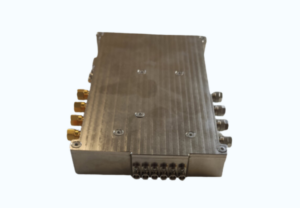
The UDC400 is fully enclosed in an aluminum housing with SMP and SMPM RF connectors, DC Flying Leads for power supply, and 6-Pin Pico-Lock connectors for power enable, PLL lock indication, current monitoring, and temperature sensing. Its compact form factor and comprehensive monitoring interfaces make it well-suited for integration into small satellite ground terminals, airborne SATCOM systems, and LEO constellation user terminals.
Documentation
Need the full ICD, test reports or a specific revision? Ask the supplier directly.