Ka-Band Satellite Transponder TR500
Arralis
The TR500 is a dual-transceiver Ka-band transponder module for LEO satellite payloads, providing 27 dBm saturated output power, sub-2.5 dB noise figure, and up to 250 MHz instantaneous bandwidth with on-board TCXO frequency stability of +/-0.28 ppm.
Technical specifications
- TX Frequency
- 17-21 GHz
- RX Frequency
- 27-31 GHz
- Saturated Output Power
- 27 dBm
- Noise Figure
- <2.5 dB
- Instantaneous Bandwidth
- Up to 250 MHz
- Reference Frequency
- 100 MHz (external or on-board TCXO)
- Frequency Stability
- +/-0.28 ppm (-40C to +85C)
- RF Connectors
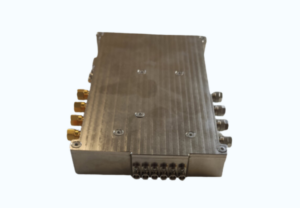
- SMP and SMPM
- DC Power Connector
- DC Flying Leads
- Control Connector
- 6-Pin Pico-Lock (enable, PLL lock, current, temperature)
- Architecture
- Dual integrated Ka-band transceivers
About
The TR500 is an integrated transponder module specifically designed for Low Earth Orbit (LEO) Ka-band satellite communication systems. It incorporates two Ka-band transceivers operating as wideband up/down converters, offering up to 250 MHz of instantaneous bandwidth with a saturated output power of 27 dBm and noise figure below 2.5 dB.
On-board frequency synthesizers can lock to an external or on-board 100 MHz reference signal provided by high-precision, low-power Temperature Compensated Crystal Oscillators (TCXO), delivering frequency stability of +/-0.28 ppm across -40C to +85C. This ensures the tight frequency tolerances required for LEO satellite constellation inter-operation without external frequency references.
The TR500 uses SMP and SMPM RF connectors for compact integration, DC Flying Leads for power, and 6-Pin Pico-Lock connectors for power enable, PLL lock indicator, current monitoring, and temperature sensing. The dual-transceiver architecture makes it suitable for satellite payloads requiring simultaneous uplink and downlink capability in compact smallsat and CubeSat platforms operating in Ka-band LEO constellations.
Documentation
Need the full ICD, test reports or a specific revision? Ask the supplier directly.