ACE is a compact Hall-effect thruster propulsion system developed by Apollo Fusion (acquired by Astra in 2021) for smallsat and constellation electric propulsion, offering multi-propellant (krypton or xenon) operation at 400 W.
Apollo Constellation Engine
ACE is a compact Hall-effect thruster propulsion system developed by Apollo Fusion (acquired by Astra in 2021) for smallsat and constellation electric propulsion, offering multi-propellant (krypton or xenon) operation at 400 W.
Description
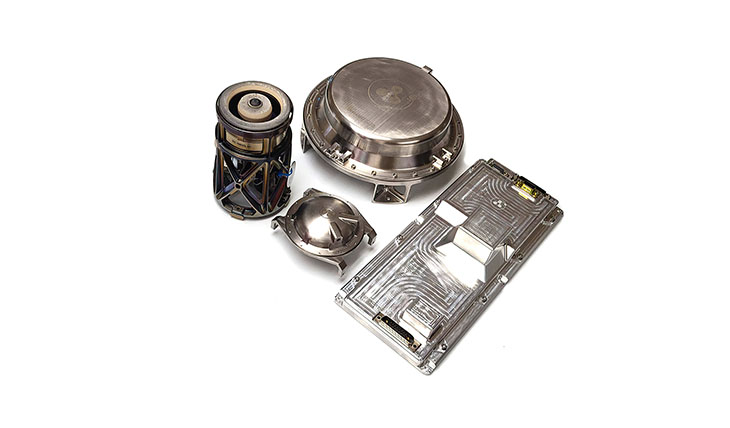
The Apollo Constellation Engine (ACE) is a clean-sheet Hall-effect thruster propulsion system built by Apollo Fusion, a spacecraft propulsion company acquired by launch and space systems company Astra in 2021. ACE is designed for satellite orbit-raising, station-keeping, deorbit, and constellation deployment, targeting the growing market of LEO smallsat constellations and GEO/cislunar spacecraft. Its innovations include multi-propellant capability with krypton, xenon, or proprietary propellants, a heaterless center-mounted instant-start cathode, novel magnetic lensing and magnetic circuit, and a 95%-efficient single-board radiation-tolerant power processing unit. The thruster (~1.0 kg) has been ground tested from 280 W to 600 W and is baselined at 400 W, delivering ~18 mN thrust and ~1,300 s Isp on krypton, or ~25 mN thrust and ~1,400 s Isp on xenon. Following Astra's acquisition, the product was rebranded as the Astra Spacecraft Engine (ASE) and offered in single- and multi-thruster configurations scaling to 1,600 W. Customers and flight heritage include York Space Systems (LEO constellation) and Spaceflight Inc.'s Sherpa-LTE orbital transfer vehicle; the thruster family has flown on multiple orbital missions and been ground-tested to over 12,000 operational cycles.
Specifications
| Thruster type | Hall-effect thruster |
|---|---|
| Propellant | Krypton, Xenon, or proprietary propellants (multi-propellant capable) |
| Input power | 400 W (operable 280-600 W) |
| Thrust (Krypton) | ~18 mN |
| Thrust (Xenon) | ~25 mN |
| Specific impulse (Krypton) | ~1,300 s |
| Specific impulse (Xenon) | ~1,400 s |
| Thruster mass | 1.0 kg |
| PPU efficiency | 95% |
| Radiation tolerance | Radiation-tolerant PPU >20 kRad (LEO, 5-year life); radiation-hardened PPU >50 kRad (up to GEO, 15-year life) |
| Flight heritage | Selected by York Space Systems for a 10+ satellite LEO constellation (2022); used on Spaceflight Inc. Sherpa-LTE orbital transfer vehicle; multiple on-orbit flights since ~2021 as Astra Spacecraft Engine; ground tested to 12,000+ cycles |