Dragonette
 Wyvern
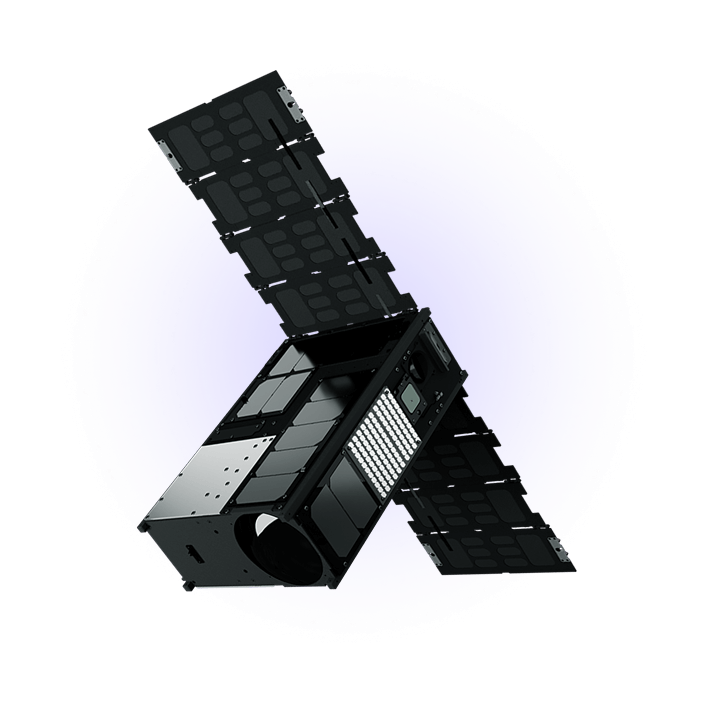
Dragonette is Wyvern's flagship hyperspectral Earth-observation smallsat, delivering 5.3 m resolution VNIR imagery across 23-31 spectral bands from a constellation of 6U cubesats.
Technical specifications
- Platform / form factor
- 6U CubeSat (EPICHyper design)
- Spectral bands
- 23 bands (Dragonette-1); 31-32 bands (Dragonette-2 onward)
- Ground sample distance
- 5.3 m at nadir
- Swath width
- 20 km at nadir
- Geolocation accuracy
- <10 m CE90 over flat terrain
- Orbit
- Sun-synchronous LEO, ~500-550 km altitude
- Revisit / repeat cycle
- Average 1.6-day constellation revisit at equator
- Flight heritage / constellation size
- 4 satellites in orbit as of mid-2026 (Dragonette-1 to -4); launched via SpaceX Transporter 7, 8, 9, and 13; Dragonette-5 and -6 planned
About
Dragonette is the flagship hyperspectral imaging satellite platform built by Canadian company Wyvern, based on the 6U EPICHyper CubeSat design manufactured with AAC Clyde Space. Each satellite carries a deployable-optics hyperspectral imager operating in the visible and near-infrared range, capturing 23 to 31 spectral bands at an industry-leading 5.3-metre ground sampling distance and a 20 km nadir swath, with geolocation accuracy better than 10 m CE90 over flat terrain. Satellites fly in sun-synchronous low Earth orbit at roughly 500-550 km altitude, completing about 15 orbits per day with an average constellation revisit of about 1.6 days at the equator. The platform targets agriculture, mining, forestry and ESG monitoring, energy, climate, and peace-and-security customers who need frequent, spectrally rich global monitoring. Flight heritage: Dragonette-1 through -3 launched in 2023 on SpaceX Transporter 7, 8 and 9 missions from Vandenberg; Dragonette-4 followed via SpaceX Transporter-13, with Dragonette-5 and -6 planned to expand the constellation and revisit frequency through 2026.
Documentation
No public datasheet yet — request the datasheet / ICD from the supplier.