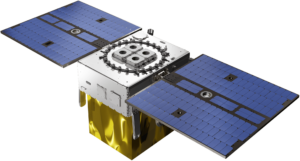
16U CubeSat Platform
 U-Space
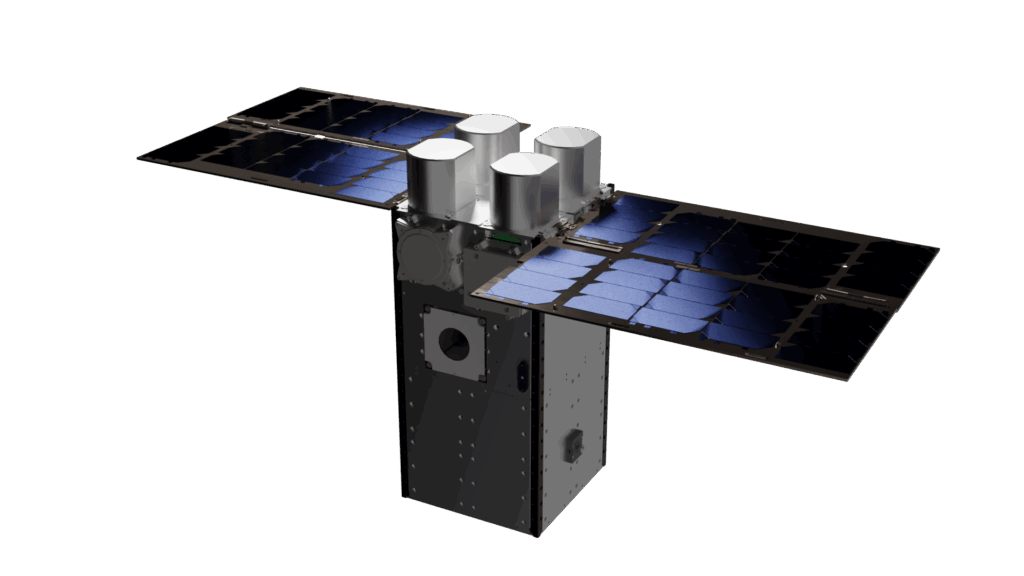
Modular 16U CubeSat bus with an 8U primary payload bay plus a dedicated 2U volume for long instruments, built for standardized, fast-turnaround constellation deployment.
Technical specifications
- Form factor
- 16U CubeSat
- Primary payload bay
- 8U (50% of satellite volume)
- Additional payload volume
- 2U, optimized for long instruments (telescopes, antennas)
- Max payload mass
- 15 kg
- Payload volume
- 10U+
- Peak power
- 200 W
- Payload Average Orbit Power (PAOP)
- LTAN 6H: 55 W; LTAN 10H30: 26 W
- Downlink
- S-Band: 400 kbit/s; X-Band: 522 Mbps
- Absolute knowledge error (AKE)
- < 0.008 deg (133 urad)
- Pointing error (APE)
- < 0.01 deg (164 urad)
- Relative pointing error (RPE, 1s)
- < 11.5 urad
- Thermal control stability
- +/- 0.2 degrees C
- Propulsion options
- Electrospray and iodine electric propulsion for constellation station-keeping
About
The 16U CubeSat platform is U-Space’s modular smallsat bus, engineered for simplified integration via standardized interfaces so it can adapt quickly to specific mission requirements. It provides an exceptional payload volume for its class: an 8U primary compartment (50% of the satellite volume) plus an additional 2U section optimized for long instruments such as telescopes and antennas. The platform features a low-electromagnetic-noise architecture to protect sensitive instrument signals, advanced GNC software delivering absolute/pointing knowledge errors under 0.008 degrees / 0.01 degrees, and one of the most precise thermal control systems in its class, holding critical payloads to +/-0.2 degrees C stability. Typical applications include greenhouse-gas and environmental monitoring Earth observation, the SOAP space-surveillance mission flown with Airbus, the PANDORE precision positioning/navigation/timing mission, and electrospray/iodine electric-propulsion constellations requiring active orbital maintenance. As with FreeForm, U-Space offers optional turnkey mission services: full satellite integration and end-to-end testing with ground-segment interoperability, hardware-in-the-loop simulator training, and standard in-orbit command, control and maintenance operations.
Documentation
Need the full ICD, test reports or a specific revision? Ask the supplier directly.