UNSW-EC0
 UNSW Sydney (ACSER)
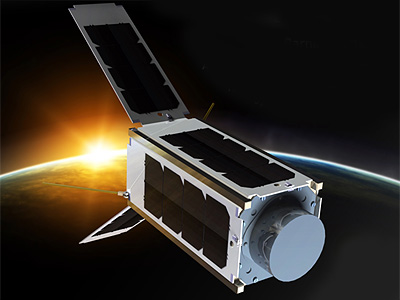
UNSW's QB50 CubeSat — 2U nanosatellite with Ion Neutral Mass Spectrometer deployed from ISS in May 2017 for lower thermosphere research.
Technical specifications
- Form factor
- 2U CubeSat
- Mass
- ~2 kg
- Launch date
- April 18, 2017 (Cygnus CRS OA-7 to ISS)
- Deployment
- May 26, 2017 (from ISS Kibo module)
- Orbit
- ~408 km (ISS altitude, decaying)
- Primary payload
- Ion Neutral Mass Spectrometer (INMS)
- Programme
- QB50 international thermosphere research constellation
- Callsign
- VK2UNS (UHF)
- Design team
- >100 ACSER students, 18+ theses
- Mission duration
- ~6 months (natural orbital decay)
About
UNSW-EC0 (also designated QB50-AU02) is a 2U CubeSat built by the Australian Centre for Space Engineering Research (ACSER) at the University of New South Wales (UNSW Sydney) as Australia’s contribution to the international QB50 constellation. QB50 was a coordinated programme of 50 CubeSats studying the in-situ properties of the lower thermosphere (200–380 km altitude) and the re-entry process.
Developed over five years with over 100 students and researchers contributing — resulting in more than 18 student theses — UNSW-EC0 was launched on April 18, 2017 aboard a Cygnus CRS OA-7 resupply mission to the International Space Station. It was subsequently deployed from the ISS Japanese Experiment Module (Kibo) on May 26, 2017 at approximately 408 km altitude.
The primary scientific payload was an Ion Neutral Mass Spectrometer (INMS), designed to measure the composition of the lower thermosphere — particularly atomic oxygen, molecular nitrogen, and trace species — in coordination with partner QB50 satellites. The satellite transmitted measurements in the UHF amateur band (callsign VK2UNS) and was tracked by ACSER’s ground station at UNSW Kensington as well as amateur radio operators globally. It operated for approximately 6 months before natural orbital decay caused re-entry. UNSW-EC0 demonstrated Australia’s capability to independently design, build, test, and operate a satellite, and formed the technical foundation for subsequent ACSER nanosatellite programmes.
Documentation
No public datasheet yet — request the datasheet / ICD from the supplier.