STARS-II (Space Tethered Autonomous Robotic Satellite II)
 Kyoto University
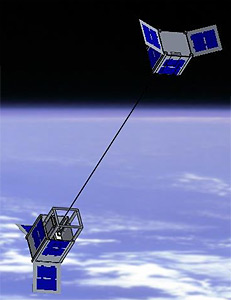
Kyoto University / Shizuoka University tethered satellite pair — Mother and Daughter CubeSats demonstrating space tether technology deployed from ISS in 2014.
Technical specifications
- Configuration
- Mother (2U) + Daughter (1U) CubeSat pair
- Tether
- Kevlar, 300 metres
- Launch
- February 2014 (HTV-3 to ISS)
- Deployment
- May 2014 (from ISS Kibo J-SSOD)
- Tether demonstration
- Partial deployment confirmed
- Orbit
- ~400 km (ISS altitude)
- Partners
- Kyoto University, Shizuoka University
- Programme
- STARS series (KUKAI 2009, STARS-II 2014, STARS-C 2016)
- Technology goal
- Space tether and electrodynamic propulsion
About
STARS-II (Space Tethered Autonomous Robotic Satellite II) is a tethered double-CubeSat system developed by a joint team from Kyoto University and Shizuoka University, Japan. It consists of two CubeSats — Mother (2U) and Daughter (1U) — connected by a 300-metre Kevlar tether, designed to demonstrate tether deployment in orbit as a step toward electrodynamic tether propulsion technology.
STARS-II was launched in February 2014 aboard HTV-3 (Kounotori 3) to the International Space Station and deployed from the Japanese Experiment Module (Kibo) via J-SSOD in May 2014. After deployment, the satellite pair attempted to extend the tether to its full length by separating the two CubeSats using a motorised spool mechanism. Although complete tether deployment was not achieved, the mechanism operated and partial tether extension was confirmed, providing valuable data for the design of STARS-C.
The STARS programme (Space Tethered Autonomous Robotic Satellite, started with KUKAI in 2009) is a long-running Kyoto University-led research series aimed at developing practical space tether technology. Potential applications include: deorbit devices for spent rocket stages (passive drag augmentation), in-orbit propulsion for propellant-free maneuvering using Earth’s magnetic field (electrodynamic tethers), and momentum exchange for orbital transfers. STARS-C (2016), built primarily at Kagawa University, advanced the programme further with a 100-metre tether system.
Documentation
No public datasheet yet — request the datasheet / ICD from the supplier.