Perun
 SpaceForest
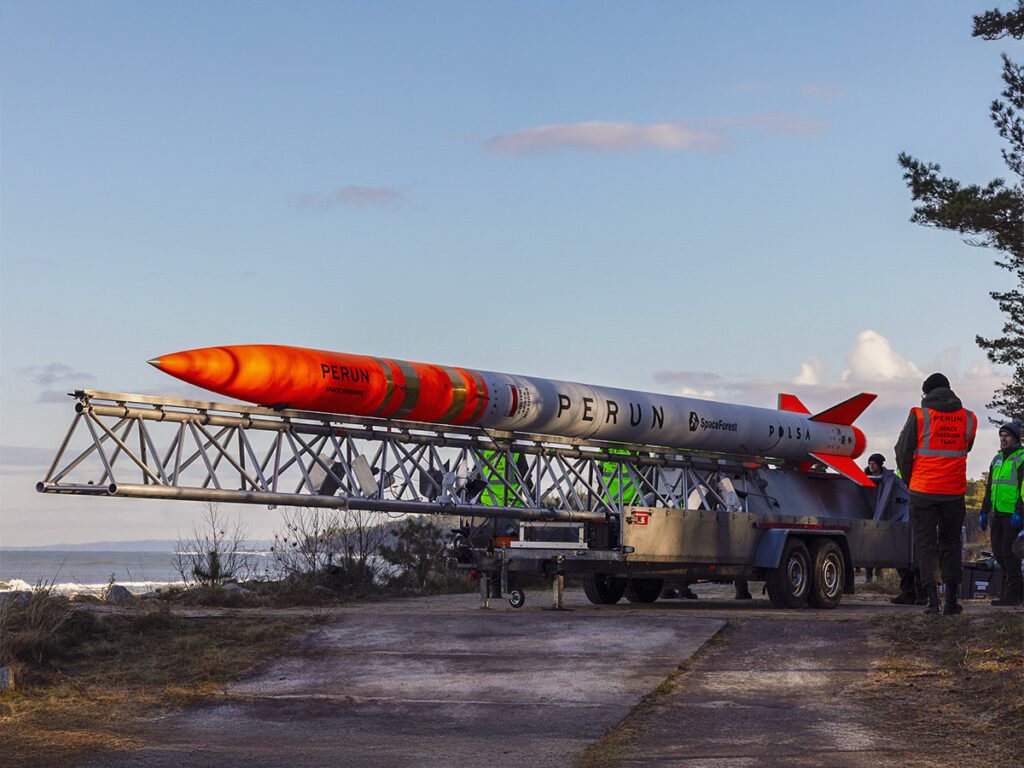
Perun is a Polish single-stage, guided suborbital rocket built by SpaceForest for microgravity research, technology testing, and payload qualification, serving as a stepping stone toward the company's future orbital launch vehicle.
Technical specifications
- Height
- 11.5 m
- Diameter
- 0.45 m
- Lift-off mass
- 970 kg
- Stages
- Single stage, guided
- Propulsion
- SF-1000 hybrid rocket motor (modified paraffin + liquid oxygen), thrust vector control
- Mean thrust
- 30 kN
- Burn time
- ~50 s
- Max apogee
- 150 km (300 km planned for upgraded version)
- Payload capacity
- Up to 50 kg separable payload
- Microgravity duration
- ~222 s below 10^-3 g; ~195 s below 10^-4 g
- Recovery system
- Ballute (balloon-parachute) recovery
- Flight heritage
- 3 suborbital test flights as of late 2025: Flight 1 (25 Jan 2020) reached ~9,750 m, fully successful; Flight 2 (21 Jun 2023) reached ~22 km, terminated early, vehicle recovered from Baltic Sea; Flight 3 (22 Nov 2025) reached ~19,300 m, terminated at 60s due to a TVC software fault, both stages and payloads recovered. Further flights planned for 2026.
About
Perun is a single-stage, guided suborbital launch vehicle developed by the Polish company SpaceForest. It is powered by the company’s own SF-1000 hybrid rocket motor, which burns modified paraffin and liquid oxygen and features thrust vector control for guided ascent, followed by cold-gas thrusters for attitude control after engine burnout. The vehicle is designed to loft a separable payload of up to 50 kg to apogees around 150 km, giving customers several minutes of microgravity conditions. After the suborbital arc, the vehicle and payload are recovered using a ballute recovery system. Perun is launched from a mobile, trailer-mounted launch rail. It targets research institutions, universities, and companies needing microgravity experiment access and hardware qualification flights, and is positioned by SpaceForest as a stepping stone toward a future Polish orbital launch vehicle. As of mid-2026, Perun has flown multiple suborbital test flights: Flight 1 (25 January 2020) reached about 9,750 m and validated structural stability and parachute recovery. Flight 2 (21 June 2023) reached about 22 km before an anomaly triggered flight termination, with the vehicle recovered from the Baltic Sea. Flight 3 (22 November 2025) reached roughly 19,300 m before a TVC software fault triggered an intentional flight termination, with both stages and payloads successfully recovered. SpaceForest has announced further flights, including a planned international sea-launch mission from the North Sea off Denmark in the second half of 2026.
Documentation
No public datasheet yet — request the datasheet / ICD from the supplier.