NewSat
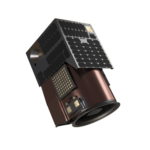 Satellogic

NewSat is Satellogic's flagship, fully vertically-integrated Earth-observation microsatellite delivering sub-meter multispectral and hyperspectral imagery as the building block of the company's Aleph-1 constellation.
Technical specifications
- Mass
- ~38.5 kg (dry mass)
- Dimensions
- 51 x 57 x 82 cm
- Multispectral resolution
- 0.4-1 m depending on satellite generation
- Hyperspectral resolution
- 30 m across 29 spectral bands
- Full-motion video
- 1 m monochromatic resolution, 10 fps, up to 60 seconds
- Imaging modes
- Spotlight, Stripes, Oblique Stripes
- Orbit
- Sun-synchronous LEO, ~440-600 km altitude, ~97.4-98° inclination
- Revisit rate
- Up to 8 times per day; roadmap toward 5-minute global revisit at 300 satellites
- Vertical integration
- In-house cameras, computers, power, sensors, optics, radios, and propulsion
- Constellation / flight heritage
- Aleph-1 constellation; 50+ operational NewSat satellites as of mid-2026, 100% deployment success rate; roadmap to 200-300 satellites
About
NewSat is Satellogic’s proprietary Earth-observation microsatellite platform, designed and manufactured in-house to drive down cost per unit while maximizing collection capacity. Each satellite measures roughly 51 x 57 x 82 cm and weighs approximately 38.5 kg. NewSat carries dual imaging payloads: a multispectral camera capable of sub-meter resolution and a hyperspectral imager covering 29 spectral bands at roughly 30 m resolution. The satellites also support monochromatic full-motion video collection at 1-meter resolution and 10 frames per second for up to 60 seconds. Three primary imaging modes are supported: Spotlight, Stripes, and Oblique Stripes. NewSat serves government, defense, agriculture, environmental monitoring, insurance, and other commercial markets requiring frequent, high-resolution geospatial data. As of mid-2026, Satellogic has launched more than 50 NewSat spacecraft (the Aleph-1 constellation), including NewSat 53 and 54 launched via SpaceX on March 30, 2026, with a 100% deployment success rate across launches. The constellation operates in Sun-synchronous low Earth orbit, currently enabling up to 8 revisits per day over points of interest, with a stated roadmap toward 200-300 satellites for near-real-time global remapping.
Documentation
No public datasheet yet — request the datasheet / ICD from the supplier.