Electron
 Rocket Lab
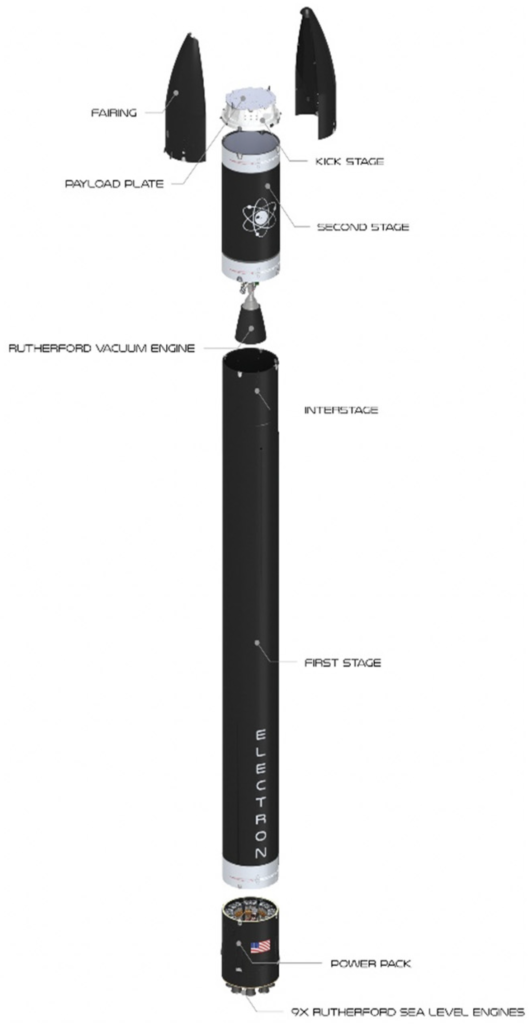
Electron is Rocket Lab's operational two-stage (optionally three-stage) small-satellite launch vehicle, built from carbon composite and powered by electric pump-fed Rutherford engines.
Technical specifications
- Height
- 18 m
- Diameter
- 1.2 m
- Mass
- 13.0 t
- Stages
- 2 (plus optional Curie kick stage)
- First stage engines
- 9x Rutherford (electric pump-fed, RP-1/LOX)
- First stage thrust
- 224.3 kN sea level / 234 kN vacuum
- Second stage engine
- 1x Rutherford (vacuum-optimized)
- Payload to LEO
- 225-300 kg
- Payload to SSO
- 150-200 kg
- Airframe material
- Carbon composite
- Recovery
- First-stage ocean splashdown recovery tested; mid-air helicopter capture attempted and later discontinued
- Flight heritage (mid-2026)
- ~91 total launches (incl. 9 suborbital HASTE missions), ~87 successful orbital missions, ~95.6% success rate; first flight 25 May 2017
About
Electron is an expendable, two-stage orbital launch vehicle developed and operated by Rocket Lab, designed to deliver small satellites to LEO and SSO on dedicated, frequent, low-cost missions. Its airframe is constructed almost entirely from carbon composite material, and it is powered by Rocket Lab’s proprietary Rutherford engines, which use an electric pump-feed cycle burning RP-1/LOX propellant; the first stage carries nine Rutherford engines while the second stage uses a single vacuum-optimized variant, with an optional Curie-powered kick stage for precise orbital insertion. First launched on 25 May 2017, Electron has become the third most-launched small-lift rocket in history, flying missions for commercial, civil, and government customers including NASA and the U.S. Space Force. Rocket Lab has also experimented with first-stage recovery via parachute-assisted ocean splashdown and mid-air helicopter capture attempts to explore reusability. As of mid-2026, Electron has completed roughly 91 total flights (including suborbital HASTE missions), with approximately 87 successful orbital missions and a success rate near 95.6%.
Documentation
No public datasheet yet — request the datasheet / ICD from the supplier.