Orbital Logistics Vehicle (OLV)
SkyCorp (Raptor Space Services)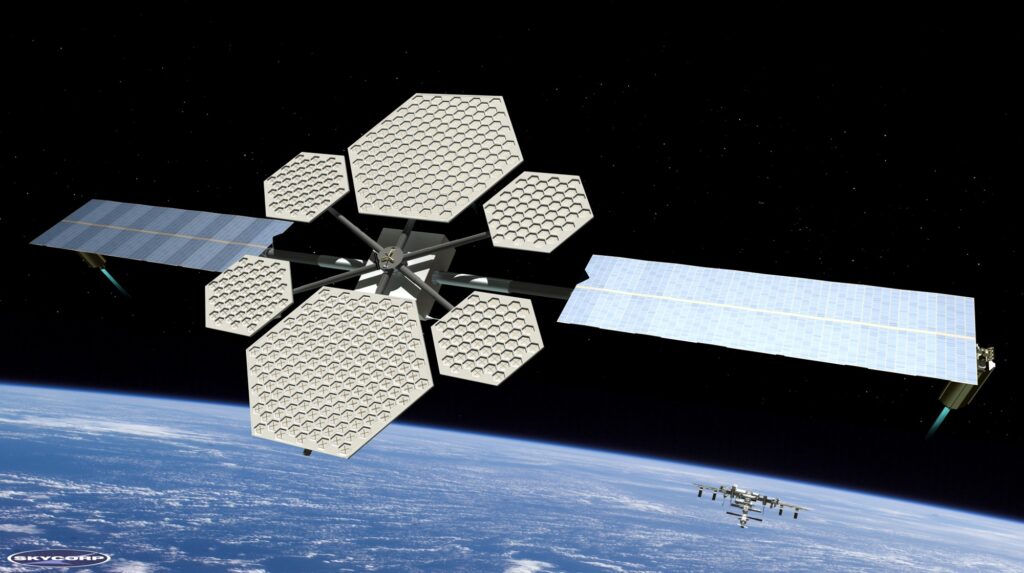
A reusable, on-orbit-assembled space platform with a standardized interface bus for hosting swappable, modular third-party payloads.
Technical specifications
- Assembly method
- On-orbit assembly at the International Space Station
- Interface
- Intelligent Space Systems Interface (iSSI) - standardized power, data, bandwidth and structural interface
- Payload integration
- Modular, swappable third-party payloads
- Flight heritage
- iSSI Fluid Quick Exchange (FQE) experiment delivered to and demonstrated on the ISS
About
The Skycorp Orbital Logistics Vehicle (OLV) ushers in a new architecture for satellites and orbital infrastructure. Instead of a fixed, purpose-built bus, the OLV is a common platform with a standardized interface that allows customized payloads from third parties to be hosted, exchanged and upgraded on orbit — doing for satellites what the Open Compute Project did for data-center hardware design.
The OLV is launched inside a protective container and assembled on orbit at the International Space Station. This approach allows the vehicle itself to use a lighter-weight design, since it does not need to be built to survive launch loads in its fully assembled configuration; the protective launch container absorbs those loads instead.
The backbone of the OLV architecture is the Intelligent Space Systems Interface (iSSI), a standardized bus interface that delivers power, data connectivity, bandwidth and physical/structural rigidity to hosted payloads. iSSI enables flexible integration of modular payloads, letting operators swap or add capability without redesigning the whole spacecraft. Skycorp flight-qualified the iSSI connector hardware through the Fluid Quick Exchange (FQE) experiment, delivered to and demonstrated aboard the International Space Station.
Combined with Skycorp’s software architecture, the OLV brings a cloud-computing-style operating model to space vehicles: modular, upgradeable payload “instances” hosted on a common, radiation-tolerant backbone, aimed at supporting a sustainable in-space logistics and servicing economy.
Documentation
Need the full ICD, test reports or a specific revision? Ask the supplier directly.