Antares 330
 Northrop Grumman Space Systems
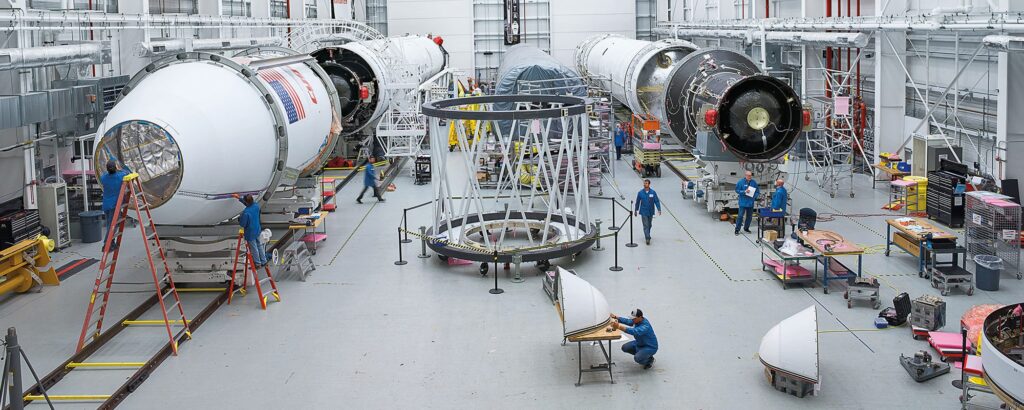
Antares 330 is Northrop Grumman's next-generation, two-stage expendable rocket designed to launch Cygnus cargo spacecraft to the ISS, replacing the retired Antares 230+ with a new Firefly Aerospace-built first stage.
Technical specifications
- Stages
- Two-stage: liquid-fueled first stage + solid-fueled second stage
- First stage engines
- 7x Firefly Aerospace Miranda engines (RP-1/LOX)
- First stage thrust
- ~7,200 kN combined
- Second stage
- Castor 30XL solid rocket motor
- Diameter
- 3.9 m (payload fairing / core)
- Payload to LEO/ISS transfer orbit
- Up to 10,500 kg
- Payload fairing
- 3.9 m diameter, removable 'pop-top' nose cone for late cargo loading
- Launch site
- Wallops Flight Facility, Virginia (Pad 0A)
- Primary mission
- Launch Cygnus cargo spacecraft on ISS resupply missions
- Flight heritage/status (mid-2026)
- Antares 330 has not yet flown; first launch targeted no earlier than 2027. Predecessor Antares 230+ flew 8 consecutive successful Cygnus missions (Nov 2019-Aug 2023) before retirement; earlier Antares 130 suffered a catastrophic launch failure on Oct 28, 2014 (Orb-3 mission).
About
Antares 330 is a two-stage orbital launch vehicle developed by Northrop Grumman in partnership with Firefly Aerospace to carry Cygnus cargo resupply spacecraft to the International Space Station from Wallops Flight Facility, Virginia. It was developed after the prior Antares 230+ variant was retired in August 2023, a move driven by the loss of access to Russian-built RD-181 first-stage engines and Ukrainian-manufactured airframe structures after Russia’s 2022 invasion of Ukraine. The Antares 330 replaces the imported first stage with an all-new, domestically produced stage built by Firefly Aerospace and powered by seven Miranda liquid-fueled engines, while retaining the proven Castor 30XL solid-fuel second stage. As of mid-2026, the Antares 330 has not yet flown; its first launch is targeted for no earlier than 2027. The legacy Antares 230+ configuration compiled a strong flight record, including 8 consecutive successful Cygnus resupply missions between November 2019 and August 2023, but the broader Antares program is best known for the catastrophic Orb-3/Antares 130 launch failure on October 28, 2014, when a turbopump failure in a refurbished Soviet-era NK-33 (AJ-26) engine caused the rocket to explode seconds after liftoff.
Documentation
No public datasheet yet — request the datasheet / ICD from the supplier.