Bishop Airlock
 Nanoracks (Voyager Technologies)
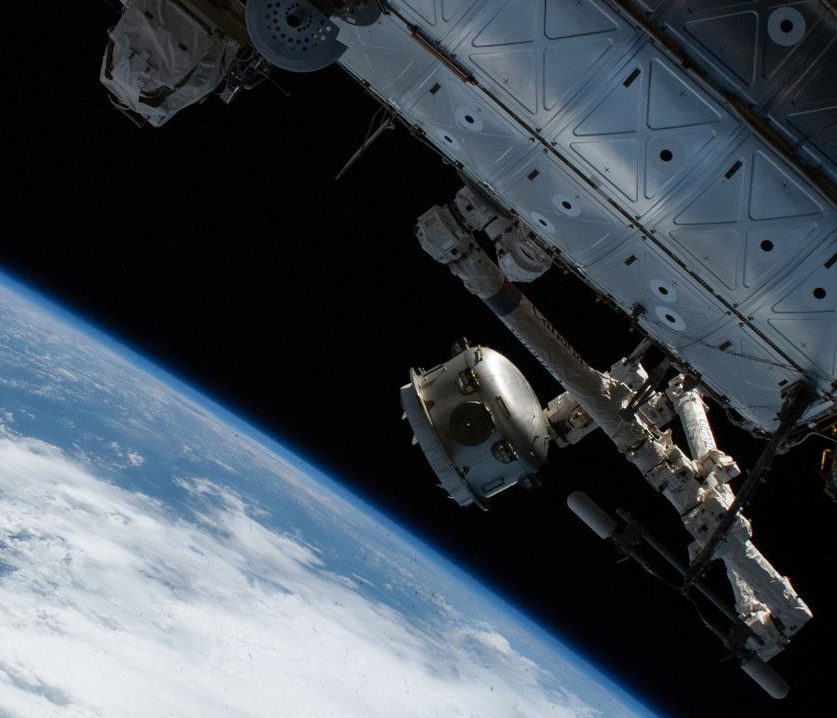
Bishop is the first permanent commercial airlock module on the International Space Station, built and operated by Nanoracks (a Voyager Technologies company) to deploy small satellites, host external payloads, and dispose of station trash.
Technical specifications
- Mass
- 1,059 kg
- Height
- 1.80 m
- Diameter
- 2.014 m
- Pressurized volume
- 3.99 m³, over 5x the volume of the ISS's existing airlock
- Max payload size
- 112 x 112 x 127 cm
- Max payload mass
- 322 kg for satellite deployment; up to 500 lb for hosted payloads
- Payload capacity
- Up to 144U per sortie
- Operating pressure range
- Vacuum to 14.7 psi
- Robotic interface
- Canadarm2 (SSRMS) for payload extraction, deployment, and berthing
- Manufacturing
- Pressure shell by Thales Alenia Space; exterior panels and berthing mechanisms by Boeing; developed by Nanoracks (Voyager Technologies)
- Flight heritage/history
- Space Act Agreement finalized May 2016; launched to ISS aboard SpaceX CRS-21 on December 6, 2020; berthed to the Tranquility (Node 3) module via Canadarm2 on December 19, 2020; first permanent commercial addition to the ISS; demonstrated trash disposal (~172 lb ejected) in a 2021 test with NASA Johnson Space Center
About
Bishop Airlock is a commercially developed and owned module permanently attached to the Tranquility (Node 3) module of the International Space Station. Built by Nanoracks, now part of Voyager Technologies, with the pressure shell manufactured by Thales Alenia Space and exterior panels/berthing mechanisms by Boeing, Bishop was designed to relieve the bottleneck created by NASA’s reliance on JAXA’s Kibo airlock for small satellite and payload deployments. Bishop has a distinctive bell-jar shape, stands about 1.80 m tall with a diameter of roughly 2.0 m, and provides a pressurized volume of about 3.99 cubic meters, over five times the capacity of the ISS’s existing government airlock, with room for up to 144U of payloads in a single sortie. Robotic operations are performed with the Canadarm2, which extracts payloads through the airlock’s outer hatch for satellite/CubeSat deployment or grapples trash bags for controlled disposal via reentry. A Space Act Agreement for Bishop was finalized in May 2016, and after schedule slips the module launched to the ISS aboard SpaceX CRS-21 on December 6, 2020, and was robotically installed on the Tranquility module on December 19, 2020. Since installation Bishop has supported numerous commercial and NASA/CASIS satellite deployment missions and, in 2021, successfully demonstrated a new trash disposal capability in collaboration with NASA’s Johnson Space Center.
Documentation
No public datasheet yet — request the datasheet / ICD from the supplier.