H3
 Mitsubishi Heavy Industries Launch Services
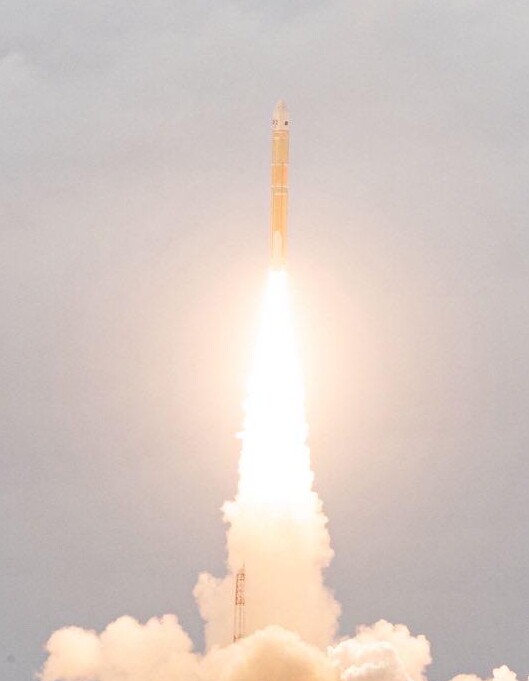
Japan's flagship two-stage liquid-fueled launch vehicle, jointly developed by JAXA and Mitsubishi Heavy Industries as the successor to the H-IIA/H-IIB family, offering flexible configurations for LEO, SSO, GTO, and interplanetary missions.
Technical specifications
- Height
- 57 m (short fairing) to 63 m (long/wide fairing)
- Diameter
- 5.27 m (core stage)
- Stages
- 2 (liquid hydrogen/liquid oxygen both stages)
- First stage engines
- 2 or 3x LE-9
- Second stage engine
- 1x LE-5B-3
- Solid rocket boosters
- 0, 2, or 4x SRB-3
- Payload to LEO (420 km)
- Up to 16,000 kg (H3-24 configuration)
- Payload to SSO (500 km)
- 4,000 kg (H3-30 configuration)
- Launch site
- Tanegashima Space Center, Japan
- Flight heritage
- 8 launches through mid-2026: TF1 (Mar 2023) failure - second-stage ignition failure; TF2 (Feb 2024) through F7 (Oct 2025) successes; F8 (Dec 2025) failure - payload support structure issue; F6 (Jun 2026) success, first H3-30 flight. Total: 6 successes / 8 launches.
About
The H3 is a two-stage, hydrogen/oxygen-fueled medium-to-heavy lift launch vehicle developed by JAXA and Mitsubishi Heavy Industries to succeed the H-IIA and H-IIB rockets, with MHI Launch Services marketing it commercially. It was designed for lower production cost, higher launch cadence, and greater flexibility, targeting government, scientific, and commercial satellite/cargo customers, including ISS resupply via HTV-X. The vehicle is offered in multiple configurations denoted by the number of first-stage LE-9 engines (2 or 3), the number of SRB-3 solid rocket boosters (0, 2, or 4), and fairing type. The first stage uses 2 or 3 LE-9 engines; the second stage uses a single LE-5B-3 engine. The rocket’s flight history includes a maiden flight failure (TF1, 7 March 2023) due to second-stage engine ignition failure, followed by a fully successful demonstration flight (TF2, 17 February 2024) and multiple successful operational missions through 2024-2025 (ALOS-4, DSN-3, QZS-6, HTV-X1). A second failure occurred on flight F8 (22 December 2025). The vehicle returned to flight successfully on 12 June 2026 with the debut of the lightweight H3-30 configuration. As of mid-2026, H3 has recorded 6 successes out of 8 total launches.
Documentation
No public datasheet yet — request the datasheet / ICD from the supplier.