Maia
 MaiaSpace
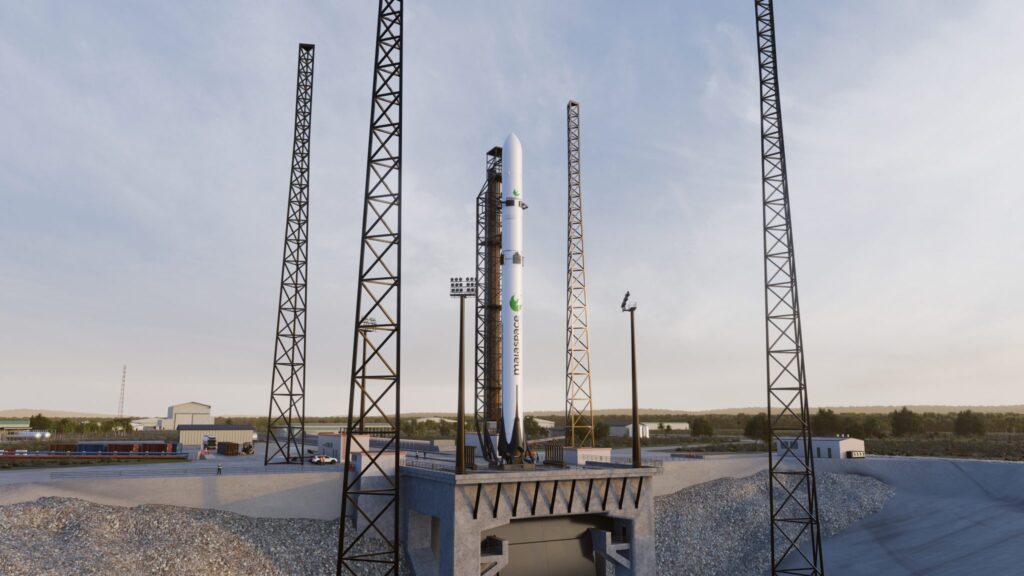
Maia is MaiaSpace's two-stage, methane/oxygen orbital launcher, billed as Europe's first reusable, eco-responsible mini launcher, designed to serve LEO/SSO smallsat constellations and heavier institutional payloads.
Technical specifications
- Height
- 50 m
- Diameter
- 3.5 m
- Stages
- 2 stages (plus optional Colibri third stage/kick stage)
- First stage engines
- 3x Prometheus engines
- Second stage engines
- 1x Prometheus engine (re-ignitable)
- Propellant
- Liquid bio-methane and liquid oxygen
- Payload to orbit (reusable)
- ~500 kg
- Payload to orbit (fully expendable)
- ~1,500 kg
- Payload to orbit (expendable + Colibri)
- ~2,500 kg
- Reusability
- First stage recovery via landing legs and grid fins, landing on a sea-based barge; target of 5 reuses per core stage
- Launch site
- ELS launch pad (former Soyuz pad), Guiana Space Centre, Kourou, French Guiana
- Flight status (mid-2026)
- In development; suborbital demonstration flight planned late 2026; inaugural orbital flight targeted 2027; first-stage recovery demonstration planned around 2028
About
Maia is the reusable small-to-medium lift orbital launch vehicle developed by MaiaSpace, a subsidiary of ArianeGroup based in France. The vehicle stands about 50 m tall with a 3.5 m diameter and uses a two-stage architecture burning liquid bio-methane and liquid oxygen. The first stage is powered by three Prometheus engines, while the re-ignitable second stage uses a single Prometheus engine; an optional third-stage ‘Colibri’ kick stage can boost performance further. The reusable first stage is equipped with landing legs, grid fins, and an attitude-control system to enable controlled descent and landing on a sea-based barge, with a goal of reusing each core stage up to five times. Payload to orbit is about 500 kg in reusable mode, 1,500 kg fully expendable, and up to roughly 2,500 kg expendable with the Colibri kick stage. As of mid-2026, Maia is still in development from the former Soyuz ELS pad in Kourou, French Guiana: MaiaSpace has completed propellant tank burst testing, a successful Colibri dual-engine firing test (September 2025), and a launch pad fit-check (October 2025), and has signed commercial agreements with Exotrail and Eutelsat. An initial suborbital demonstration flight is planned for late 2026, ahead of an inaugural orbital flight targeted for 2027.
Documentation
No public datasheet yet — request the datasheet / ICD from the supplier.