LeoLabs Global Radar Network
 LeoLabs
LeoLabs' 24/7 global network of ground-based phased-array radars that persistently tracks satellites and orbital debris in low Earth orbit to power space domain awareness, collision avoidance, and space traffic management services.
Technical specifications
- Network operation
- 24/7 global radar network
- Coverage
- Northern Hemisphere, Southern Hemisphere, and Equatorial regions
- Current sites
- Australia, Azores, Costa Rica, New Zealand, Texas
- Tracker radar technology
- Phased Array Offset-Fed Reflector
- Tracker detection capability
- Spacecraft and >10cm debris tracking
- Scout-S radar technology
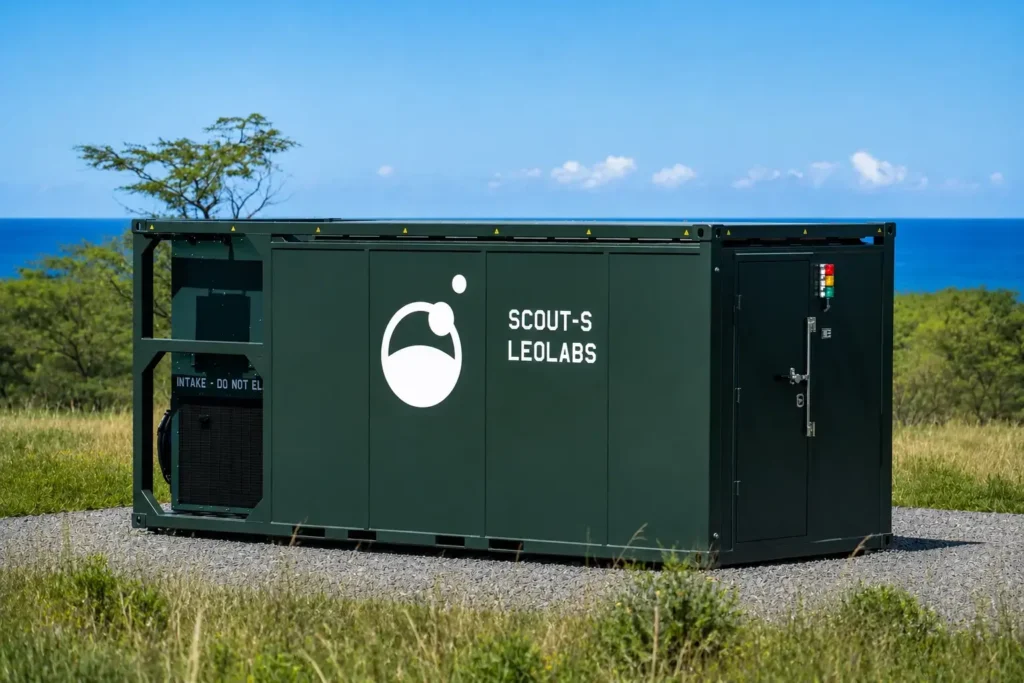
- S-band Direct Radiating Array, transportable in a 20 ft ISO container
- SEEKER radar technology
- UHF planar Direct Radiating Array (in development)
- RANGER radar technology
- Scalable S-band Direct Radiating Array, <10cm debris detection (in development)
- Scheduling improvement
- AI-optimized dynamic scheduling enables ~40% more frequent tracking
About
The LeoLabs Global Radar Network is the flagship space situational awareness infrastructure underpinning LeoLabs’ ‘Persistent Orbital Intelligence’ offering. It is a distributed, 24/7 network of multi-mission, phased-array radar systems deployed across the Northern and Southern Hemispheres and the Equatorial belt, including sites in Australia, the Azores, Costa Rica, New Zealand, and Texas. The network comprises several radar system families: Tracker, a proliferated Phased Array Offset-Fed Reflector system for spacecraft and debris (>10cm) tracking; Scout-S, a rapidly deployable S-band radar housed in a standard 20 ft ISO container for uncued object search and foreign launch detection; SEEKER, a UHF planar radar in development for spacecraft tracking and MEO/GEO/cislunar research; and RANGER, a scalable next-generation S-band radar aimed at sub-10cm debris detection. AI-driven dynamic scheduling models optimize beam allocation, enabling objects to be tracked roughly 40% more frequently than static scheduling. Data feeds LeoLabs’ cloud-based analytics platform, serving commercial satellite operators, government agencies, and defense customers with conjunction/collision alerts and space traffic management across tens of thousands of tracked LEO objects.
Documentation
No public datasheet yet — request the datasheet / ICD from the supplier.