ASCA Reusable Launch Vehicle
 Innovative Space Carrier (ISC)
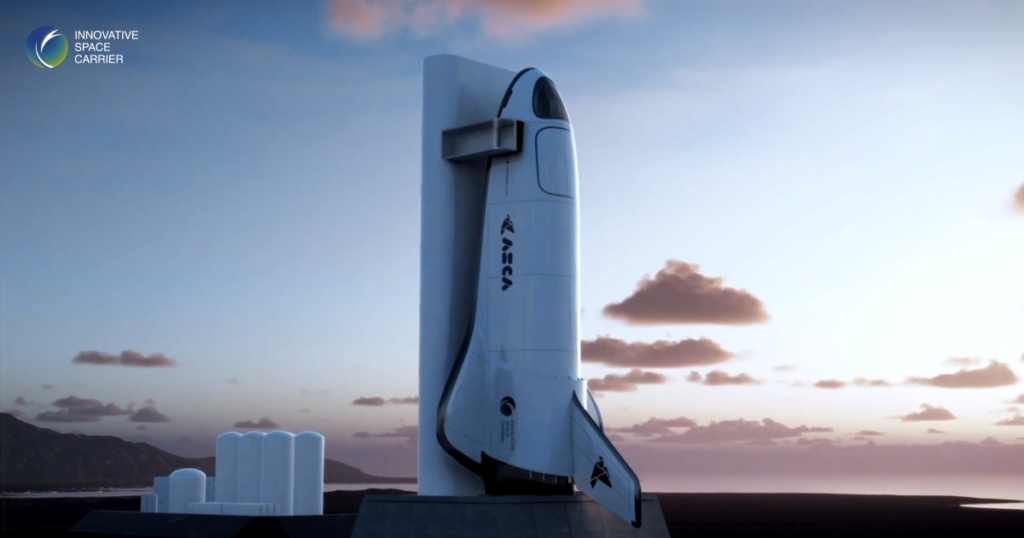
Single-stage-to-orbit reusable rocket designed for daily orbital operations — 10-tonne payload to 400 km LEO, 50-passenger capacity, 1,000+ reuse flights, once-per-day turnaround.
Technical specifications
- Vehicle Type
- Single-Stage-to-Orbit (SSTO), Reusable
- Payload to LEO (400 km)
- 10,000 kg
- Passenger Capacity
- 50
- Reuse Lifetime
- >1,000 flights
- Turnaround Time
- 1 day (target)
- ASCA 1.0 Total Length
- 8,290 mm
- ASCA 1.0 Diameter
- 2,000 mm
- ASCA 1.0 Dry Mass
- 2,629 kg
- ASCA 1.0 Gross Mass
- 3,192 kg
- ASCA 1.0 Max Altitude (test)
- 100 m
- ASCA 1.0 Flight Duration (test)
- 34 s
- Commercial Service Target
- 2028
About
ASCA is a single-stage-to-orbit (SSTO) reusable launch vehicle under development by Innovative Space Carrier Inc. (ISC). Designed for the same operational frequency and reliability as commercial aviation, ASCA targets a turnaround capability of once per day with a vehicle lifetime exceeding 1,000 reflights through modular inspection, maintenance, and component replacement.
In its orbital configuration, ASCA is sized to deliver 10-tonne payloads to low Earth orbit at approximately 400 km altitude, and to carry up to 50 passengers in configurations optimized for space tourism or suborbital point-to-point transportation connecting distant cities within 60 minutes of flight time.
Development follows a three-phase roadmap extending to the 2040s. ASCA 1.0 is the first subscale test article (8,290 mm tall, 2,000 mm diameter, 2,629 kg dry mass), focused on acquiring attitude control and guidance control technology for the vertical landing phase and establishing maintenance and operational procedures for rapid reuse. Initial hop tests reached 100 m altitude over a 34-second flight duration.
ISC accelerates development using its proprietary P4SD platform — a cloud-based space engineering environment integrating flight simulators, digital twin virtual testing (SILs/HILs), aerodynamic and structural solvers, and additive manufacturing tooling — applying software DevOps methodology to rocket development to compress multi-year design cycles into single-year iterations. Commercial service is targeted to begin in 2028.
Documentation
No public datasheet yet — request the datasheet / ICD from the supplier.