HANBIT-Nano
INNOSPACE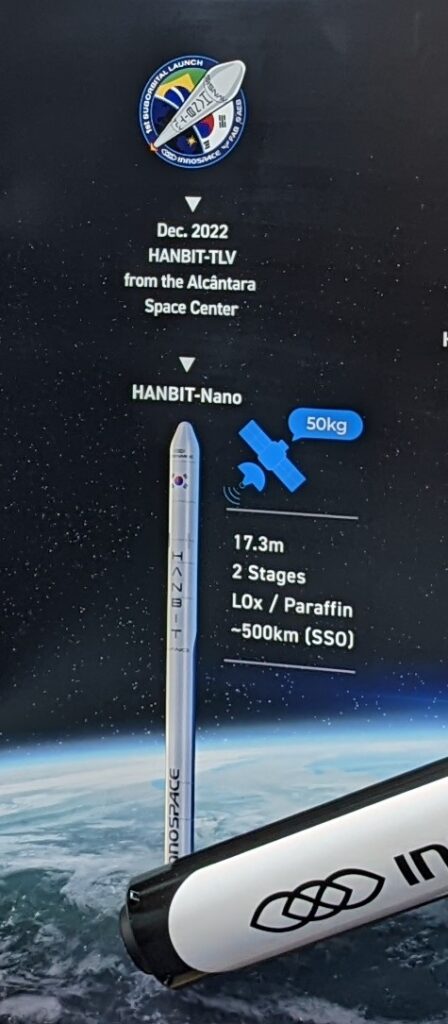
A two-stage, small-lift orbital launch vehicle developed by South Korean startup INNOSPACE, notable for using hybrid (paraffin/LOx) rocket propulsion in its first stage.
Technical specifications
- Height
- 21.8 m
- Diameter
- 1.4 m
- Stages
- 2
- First stage propulsion
- Single 25-ton-class hybrid engine, paraffin fuel / LOx oxidizer, ~245 kN thrust
- Second stage propulsion
- Interchangeable: 3.5-ton 'Hyper' hybrid engine or 3-ton 'LiMER' LOx/methane engine
- Payload to SSO (500 km)
- 90 kg
- Payload to LEO
- ~50 kg
- Launch site
- Alcântara Space Center, Brazil
- Flight heritage/status
- Suborbital hybrid engine test succeeded March 2023; maiden orbital launch 'Spaceward' on Dec 22-23, 2025 failed when first-stage combustion chamber ruptured ~33 seconds after liftoff; second orbital launch attempt planned for 2026
About
HANBIT-Nano is a 21.8 m tall, 1.4 m diameter, two-stage small-satellite launch vehicle developed by South Korean space startup INNOSPACE. Its first stage is powered by a single 25-ton-class hybrid rocket engine burning paraffin fuel with liquid oxygen oxidizer, producing roughly 245 kN of thrust. The second stage is offered with an interchangeable engine: either a 3.5-ton ‘Hyper’ hybrid engine or a 3-ton ‘LiMER’ LOx/liquid-methane engine. The vehicle is aimed at the small-satellite and CubeSat launch market, capable of delivering approximately 90 kg to a 500 km sun-synchronous orbit. Flight heritage: after a suborbital hybrid-engine test flight from Brazil in March 2023, INNOSPACE conducted the maiden orbital launch of HANBIT-Nano, mission ‘Spaceward,’ from Brazil’s Alcântara Space Center on December 22-23, 2025. The rocket lifted off normally, but approximately 33 seconds into flight exhaust leaked from the first-stage combustion chamber, causing it to rupture and the vehicle to break apart roughly 80 seconds after liftoff; the mission failed to reach orbit. INNOSPACE completed a failure investigation and plans a second HANBIT-Nano orbital launch in 2026.
Documentation
No public datasheet yet — request the datasheet / ICD from the supplier.