GRBAlpha
 Masaryk University
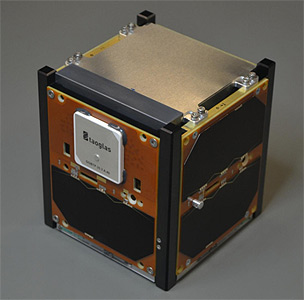
1U CubeSat gamma-ray burst detector led by Masaryk University — launched March 2021, detected 140+ GRBs from 550 km SSO orbit during 4-year operational life.
Technical specifications
- Form factor
- 1U CubeSat
- Mass
- ~1 kg
- Launch date
- March 22, 2021
- Launch vehicle
- Soyuz-2.1a (Baikonur)
- Orbit
- 550 km sun-synchronous
- Detector
- CsI(Tl) scintillator + SiPMs
- Energy range
- 30 keV – 1 MeV
- GRBs detected
- >140 confirmed gamma-ray bursts
- Operational life
- 4+ years (de-orbited June 2025)
- Partners
- Masaryk University (CZ), Konkoly Observatory (HU), Osaka University (JP), IEP SAS (SK)
- Successor
- GRBBeta (Ariane 6, July 2024)
About
GRBAlpha is a 1U CubeSat (10×10×10 cm) gamma-ray burst detector developed by a collaboration led by Masaryk University (Brno, Czech Republic) with partners from Hungary, Japan, and Slovakia. It was launched on March 22, 2021, aboard a Soyuz-2.1a rocket from the Baikonur Cosmodrome into a 550 km sun-synchronous orbit.
The satellite’s primary scientific instrument is a scintillator-based gamma-ray detector (cesium iodide crystal, CsI(Tl)) coupled to silicon photomultipliers (SiPMs), sensitive to photon energies from approximately 30 keV to 1 MeV — the energy range of prompt gamma-ray burst emission. During its operational lifetime of 4+ years, GRBAlpha detected over 140 confirmed gamma-ray bursts from cosmological distances, as well as X-ray transients, solar flares, and magnetar outbursts, demonstrating conclusively that 1U CubeSat-class instruments can contribute meaningfully to time-domain astrophysics.
GRBAlpha served as the technological pathfinder for CAMELOT — a planned constellation of 9 similar CubeSats for all-sky monitoring of gamma-ray transients and improving their localisation. GRBBeta (launched on Ariane 6 in July 2024) is the successor mission with an improved detector. GRBAlpha naturally de-orbited in June 2025 after completing its scientific program, leaving a rich dataset used by the global high-energy astrophysics community.
Documentation
No public datasheet yet — request the datasheet / ICD from the supplier.