ESEO De-Orbiting Mechanism (DOM)
 Cranfield University
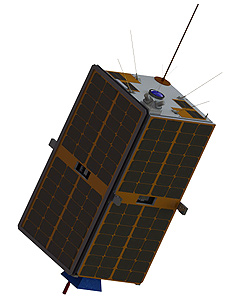
Cranfield student-built deployable drag sail for the ESA European Student Earth Orbiter (ESEO) — launched December 2018 on SpaceX Falcon 9 for passive de-orbit demonstration.
Technical specifications
- Type
- Deployable drag sail (de-orbit device)
- Deployed area
- 0.25 m²
- Material
- Aluminised Kapton film on spring-loaded booms
- Host spacecraft
- ESEO (European Student Earth Orbiter)
- Launch date
- December 3, 2018
- Launch vehicle
- SpaceX Falcon 9 (SSO-A: SmallSat Express)
- Orbit
- 575 km sun-synchronous
- Technology
- Passive aerodynamic de-orbit (no propellant)
- ESA programme
- SSETI (Student Space Exploration and Technology Initiative)
- Consortium
- 10 European universities under ESA Education
About
The De-Orbiting Mechanism (DOM) is a deployable drag sail subsystem developed by students at Cranfield University’s Centre for Autonomous and Cyber-Physical Systems, as Cranfield’s contribution to the European Student Earth Orbiter (ESEO) mission organised by ESA’s Education Office. ESEO is a microsatellite developed by a consortium of 10 European universities under ESA Education’s SSETI (Student Space Exploration and Technology Initiative) programme.
The Cranfield DOM consists of a deployable 0.25 m² drag sail built from aluminised Kapton film on spring-loaded booms. When commanded, the sail deploys from a compact stowed volume to increase the satellite’s cross-sectional area, dramatically increasing atmospheric drag and accelerating the end-of-life deorbit. This passive de-orbit technology — which requires no propellant — is critical for small satellite debris mitigation compliance, particularly as low Earth orbit becomes increasingly congested.
ESEO was launched on December 3, 2018, aboard a SpaceX Falcon 9 as part of the SSO-A: SmallSat Express rideshare mission into a 575 km sun-synchronous orbit. The DOM was one of several technology demonstrations on ESEO, alongside an onboard camera, radiation monitor, and communication systems contributed by partner universities. The Cranfield-developed DOM was successfully deployed in orbit, validating the design at a tiny 5% of the development cost of a conventional propulsive de-orbit system.
The DOM project trained a generation of Cranfield MSc Astronautics students in hardware design, integration, space qualification testing, and operations. Cranfield has subsequently used this experience to develop more advanced deorbit sail concepts for commercial smallsats.
Documentation
No public datasheet yet — request the datasheet / ICD from the supplier.