Long March 5
 CASC — China Aerospace Science and Technology Corp.
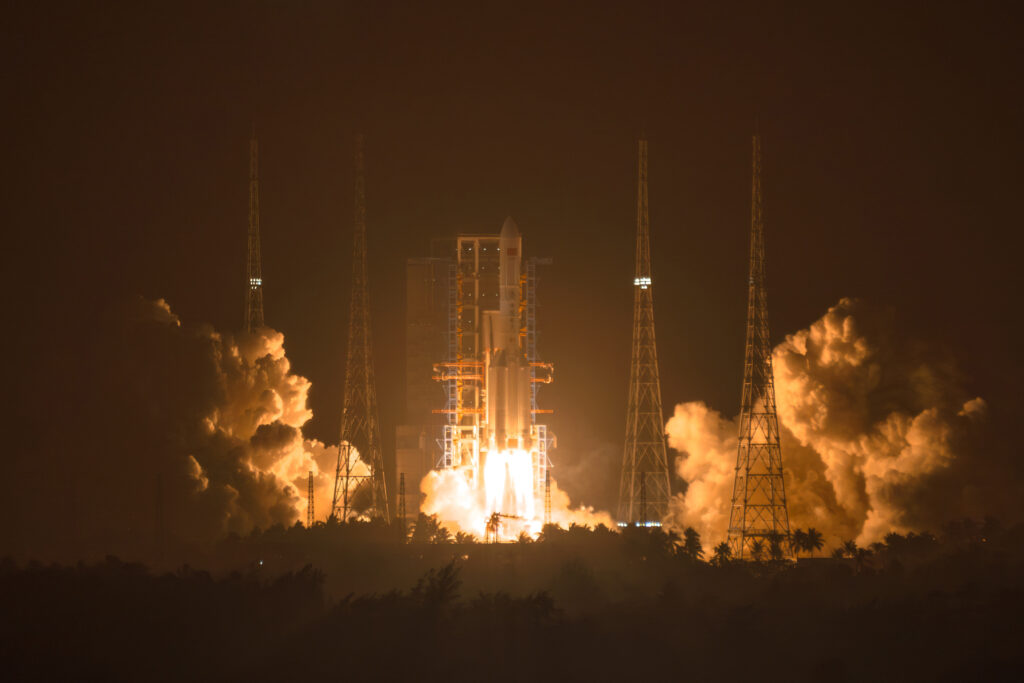
The Long March 5 is CASC's flagship heavy-lift launch vehicle, China's most powerful operational rocket, used to loft the country's largest satellites, deep-space probes, and space station modules.
Technical specifications
- Height
- 56.97 m (standard); 63.2 m (extended fairing variant)
- Diameter
- 5 m core stage; 5.2 m payload fairing
- Launch mass
- 851,800 kg (CZ-5); 837,500 kg (CZ-5B)
- Stages
- 2 main stages plus 4 strap-on boosters (CZ-5); no upper stage (CZ-5B)
- Booster engines
- 4x boosters, each with 2x YF-100 (LOX/RP-1)
- Core stage engines
- 2x YF-77 (LOX/LH2)
- Second stage engines
- 2x YF-75D (LOX/LH2), CZ-5 configuration only
- Payload to LEO
- ~25,000 kg (CZ-5B, 200 km orbit)
- Payload to GTO
- 14,000 kg
- Payload to TLI
- 8,800-9,400 kg
- Launch site
- Wenchang Space Launch Site, LC-1
- Flight heritage
- 18 total launches as of June 2026 (11 CZ-5, 7 CZ-5B), 17 successes and 1 failure, 94.4% success rate; key missions include Chang'e-5 (2020) and Chang'e-6 (2024) lunar sample-return, Tianwen-1 Mars mission (2020), and Tiangong space station modules Tianhe/Wentian/Mengtian
About
Developed by the China Academy of Launch Vehicle Technology under China Aerospace Science and Technology Corporation (CASC), the Long March 5 is a two-stage (three-stage optional), 5-meter-diameter heavy-lift rocket. Its core stage uses two YF-77 LOX/liquid-hydrogen engines augmented by four strap-on boosters each carrying two YF-100 LOX/kerosene engines; the standard CZ-5 configuration adds a cryogenic YF-75D-powered second stage, while the crewed/cargo-oriented CZ-5B variant flies without an upper stage for direct low-orbit insertion of large payloads. Launched from the coastal Wenchang Space Launch Site, the vehicle targets the heavy-lift market for national deep-space, lunar, and space-station missions. Long March 5 debuted in November 2016 and suffered a core-stage failure on its second flight in 2017, leading to a 28-month grounding before returning to flight in December 2019. Since then it has launched the Chang’e-5 (2020) and Chang’e-6 (2024) lunar sample-return probes, the Tianwen-1 Mars orbiter-lander-rover (2020), and the CZ-5B variant carrying the Tianhe (2021), Wentian (2022), and Mengtian (2022) modules that form the core of the Tiangong space station.
Documentation
No public datasheet yet — request the datasheet / ICD from the supplier.