Acadia
 Capella Space
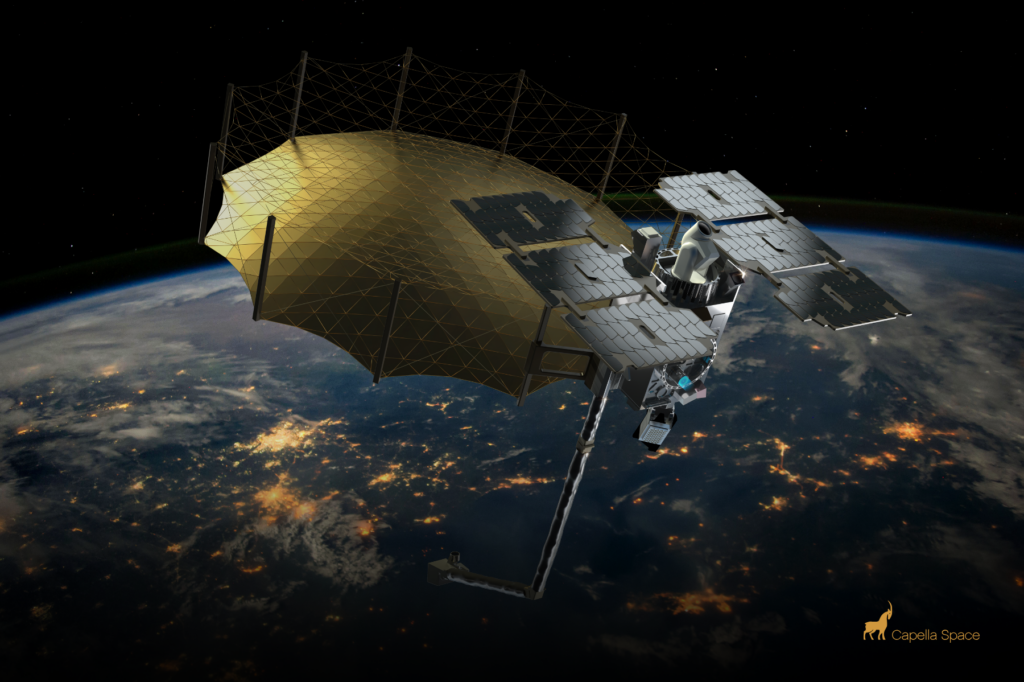
Acadia is Capella Space's third-generation X-band Synthetic Aperture Radar (SAR) small satellite, delivering the highest-resolution commercial SAR imagery available with increased bandwidth, power, and optical inter-satellite links.
Technical specifications
- Satellite mass
- Less than 197 kg
- Deployed antenna area
- Approximately 8 m² mesh reflector
- Radar band
- X-band SAR
- Radar bandwidth
- 700 MHz (up from 500 MHz on prior generation)
- Slant range resolution
- Down to 0.214 m
- Spotlight mode resolution
- ~0.25 m azimuth resolution, 5x5 km scene
- Stripmap mode resolution
- ~1.2 m resolution, up to 100x10 km swath
- Communications
- Mynaric optical communications terminals, Optical Inter-Satellite Links compatible with SDA National Defense Space Architecture
- Orbit types
- 45° and 53° mid-inclination and 97° sun-synchronous, ~525-575 km altitude
- Flight heritage
- Acadia-1 launched Aug 23, 2023 (Rocket Lab Electron); Acadia-2 lost in Sept 2023 launch failure; Acadia-3 through 10+ launched 2024-2026 via Rocket Lab Electron and SpaceX rideshare
About
Acadia is Capella Space’s third-generation SAR satellite platform, designed to expand and upgrade the company’s commercial radar imaging constellation. Each Acadia-class satellite has a launch mass of less than 197 kg and deploys a large mesh reflector antenna spanning approximately 8 square meters once on orbit. The spacecraft carries an X-band SAR payload with radar bandwidth increased to 700 MHz and transmit power boosted more than 40% compared to Capella’s second-generation Whitney-class satellites, enabling slant range resolution as fine as 0.214 m. Acadia supports spotlight, sliding spotlight, and stripmap imaging modes, providing all-weather, day-and-night imaging that penetrates cloud cover. Acadia satellites are equipped with Mynaric optical communications terminals, making Capella the first commercial SAR company to demonstrate Optical Inter-Satellite Links compatible with the U.S. Space Development Agency’s National Defense Space Architecture. Target markets include U.S. and allied government/defense agencies, intelligence users, and commercial customers needing rapid-revisit, high-resolution geospatial intelligence. Flight heritage: Acadia-1 launched August 23, 2023 aboard a Rocket Lab Electron from New Zealand; Acadia-2 was lost in a September 2023 launch failure; subsequent Acadia satellites launched between 2024 and 2026 via Rocket Lab Electron and SpaceX rideshare missions, growing Capella’s operational constellation, which has been providing commercial SAR imagery since 2020.
Documentation
No public datasheet yet — request the datasheet / ICD from the supplier.