Astrocast Nanosatellite
 Astrocast
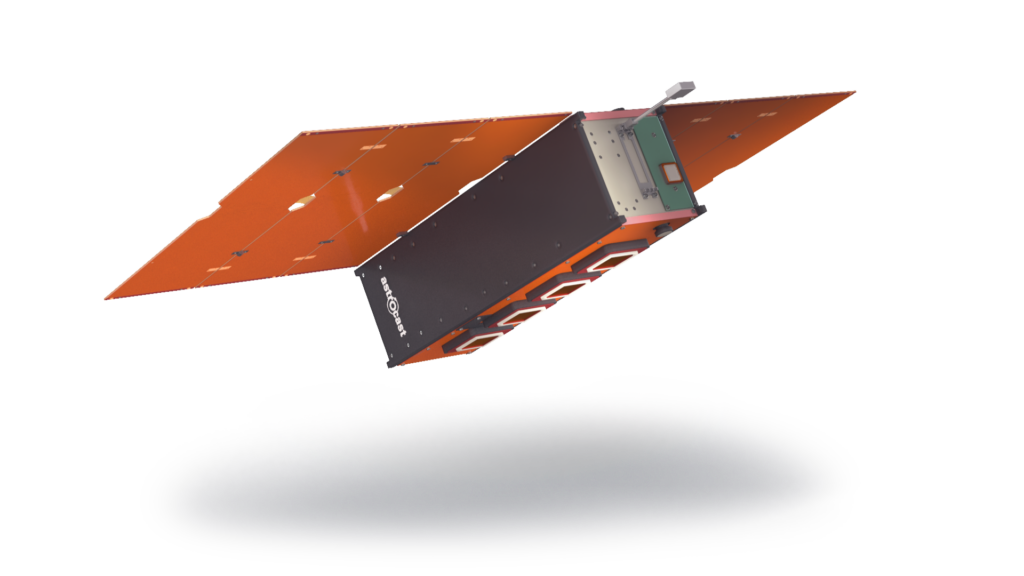
Astrocast's 5 kg-class 3U CubeSat nanosatellite forms the space segment of its L-band satellite IoT network, providing low-cost, bidirectional connectivity to remote and off-grid IoT devices worldwide.
Technical specifications
- Form factor
- 3U CubeSat
- Mass
- 5 kg class
- Frequency band
- L-band (1-2 GHz)
- Encryption
- 256-bit
- Orbit
- LEO, sun-synchronous and equatorial orbits, ~500-540 km altitude
- Operational lifetime
- 3-5 years (controlled)
- Special features
- Onboard propulsion and deorbiting capability for debris mitigation
- Constellation size
- Approximately 18-20 satellites in orbit
- Launch history
- Dec 2018 SpaceX SSO-A; Apr 2019 ISRO PSLV-C45; Jan/Jun 2021 SpaceX Transporter-1/2; Nov 2022 ISRO PSLV-C54; Jan 2023 SpaceX Transporter-6
About
The Astrocast Nanosatellite is the flagship spacecraft platform built by Swiss company Astrocast SA to deliver direct-to-satellite IoT connectivity from low Earth orbit. Each satellite is a 5 kg-class 3U CubeSat built in-house, with propulsion and deorbiting capabilities to limit orbital debris, redundant critical components, and a controlled operational lifetime of 3-5 years. The satellites operate using a proprietary low-power L-band chipset, making Astrocast the only NewSpace LEO IoT operator with access to L-band frequencies, which supports low-latency, encrypted bidirectional links to small, battery-powered IoT terminals. The platform targets asset tracking, environmental monitoring, agriculture, maritime, and other IoT applications in remote or off-grid areas beyond terrestrial network coverage. Flight heritage includes a first test satellite (‘Kiwi’) launched in December 2018 on a SpaceX rideshare, followed by a second test satellite (‘Hawaii’) launched in April 2019 on ISRO’s PSLV-C45. Operational batches followed via SpaceX Transporter-1 and Transporter-2 (2021), ISRO PSLV-C54 (2022), and SpaceX Transporter-6 (2023), bringing the constellation to roughly 18-20 satellites in orbit.
Documentation
No public datasheet yet — request the datasheet / ICD from the supplier.