Kuiper Satellite
 Amazon (Project Kuiper)
Amazon's Kuiper satellite is the production spacecraft for Project Kuiper (rebranded Amazon Leo), a low Earth orbit constellation designed to deliver high-speed, low-latency broadband internet globally.
Technical specifications
- Satellite mass
- ~537-571 kg
- Planned constellation size
- 3,236 satellites
- Orbital planes
- 98
- Orbit altitude
- 590-630 km LEO (three shells)
- Optical inter-satellite link throughput
- Up to 100 Gbps per link
- Customer terminal downlink speed
- 100 Mbps - 1 Gbps
- User antenna
- Electronically steered Ka-band phased array, ~30 cm diameter
- Propulsion
- In-house Hall-effect thruster, krypton propellant
- Onboard processor
- Custom 'Prometheus' baseband System-on-Chip
- Satellites deployed (Jul 2026)
- ~396 production satellites across 14 missions
- Launch vehicles used
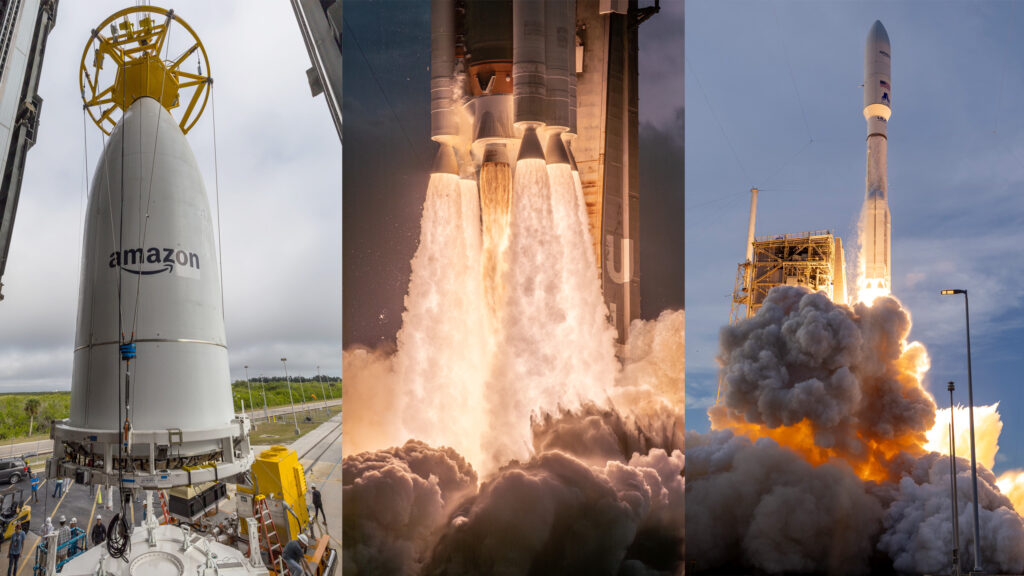
- ULA Atlas V 551, SpaceX Falcon 9, Arianespace Ariane 6 (Vulcan and Blue Origin New Glenn planned)
About
The Kuiper satellite is Amazon’s mass-produced LEO communications spacecraft built to populate a planned 3,236-satellite constellation across 98 orbital planes at altitudes between 590 km and 630 km. Each satellite uses a trapezoidal bus with deployable solar arrays, electronically steered Ka-band phased-array antennas for customer links, and optical inter-satellite links capable of up to 100 Gbps between satellites to route traffic without relying solely on ground gateways. Station-keeping and deorbit maneuvers are handled by an in-house Hall-effect thruster using krypton propellant, with a custom Amazon-designed ‘Prometheus’ baseband processor for onboard networking. The system targets consumer, enterprise, and government customers lacking reliable connectivity, offering service via Leo Nano, Leo Pro, and Leo Ultra customer terminals with speeds up to 1 Gbps. As of the July 2026 update, Amazon had deployed roughly 396 production satellites across 14 missions since full-scale deployment began in April 2025, using ULA Atlas V 551, SpaceX Falcon 9, and Arianespace Ariane 6, with over 100 launches secured overall and an initial commercial service rollout planned for later in 2026.
Documentation
No public datasheet yet — request the datasheet / ICD from the supplier.