Mechanical Testing for Space Components
 ALTER Technology
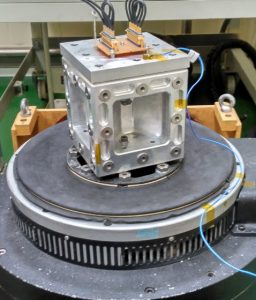
ALTER Technology provides vibration, shock, and constant acceleration testing for space components to validate structural integrity under launch and operational stress, with capabilities up to 50,000 g.
Technical specifications
- Constant Acceleration Capability
- Up to 50,000 g
- Vibration Test Types
- Sine, random, sine-on-random, random-on-random
- Vibration Standards
- ECSS-Q-ST-70-08C, ECSS-Q-ST-70-38C, EN 60068-2-6, EN 60068-2-64, ISO 19683, EN 61373
- Shock Methods
- Classical mechanical shock, Shock Response Spectrum (SRS)
- Shock Standards
- EN 60068-2-27, MIL-STD-202, MIL-STD-883, ECSS-Q-ST-70-38C, ISO 19683
- Constant Acceleration Standards
- MIL-STD-883 Method 2001, MIL-STD-202 Method 212, ECSS-Q-ST-70-08C
- Electrical Monitoring
- During and post-test
- Custom Fixtures
- In-house design capability
About
ALTER Technology provides mechanical testing services to validate robustness and reliability of electronic components under extreme physical stress for aerospace, defense, and transportation sectors. Vibration testing reproduces dynamic mechanical stresses from transportation, launch, or operational use using electrodynamic shakers and SRS tables, supporting sine, random, sine-on-random, and random-on-random tests with custom tooling, electrical monitoring during vibration, and combined thermal-vibration testing. Standards: ECSS-Q-ST-70-08C, ECSS-Q-ST-70-38C, EN 60068-2-6, EN 60068-2-64, ISO 19683, EN 61373. Shock testing evaluates resilience to sudden mechanical impulses using classical mechanical shock and SRS methods with drop towers, impact hammers, or electrodynamic shakers, high-speed data acquisition, and combined mechanical and electrical monitoring. Standards: EN 60068-2-27, MIL-STD-202, MIL-STD-883, ECSS-Q-ST-70-38C, ISO 19683. Constant acceleration testing determines mechanical strength under steady-state high-g load conditions with capability up to 50,000 g, custom mounting fixtures, and evaluation of mechanical and solder joint integrity. Standards: MIL-STD-883 Method 2001, MIL-STD-202 Method 212, ECSS-Q-ST-70-08C.
Documentation
No public datasheet yet — request the datasheet / ICD from the supplier.