ACE-FTS
ABB (Space Division)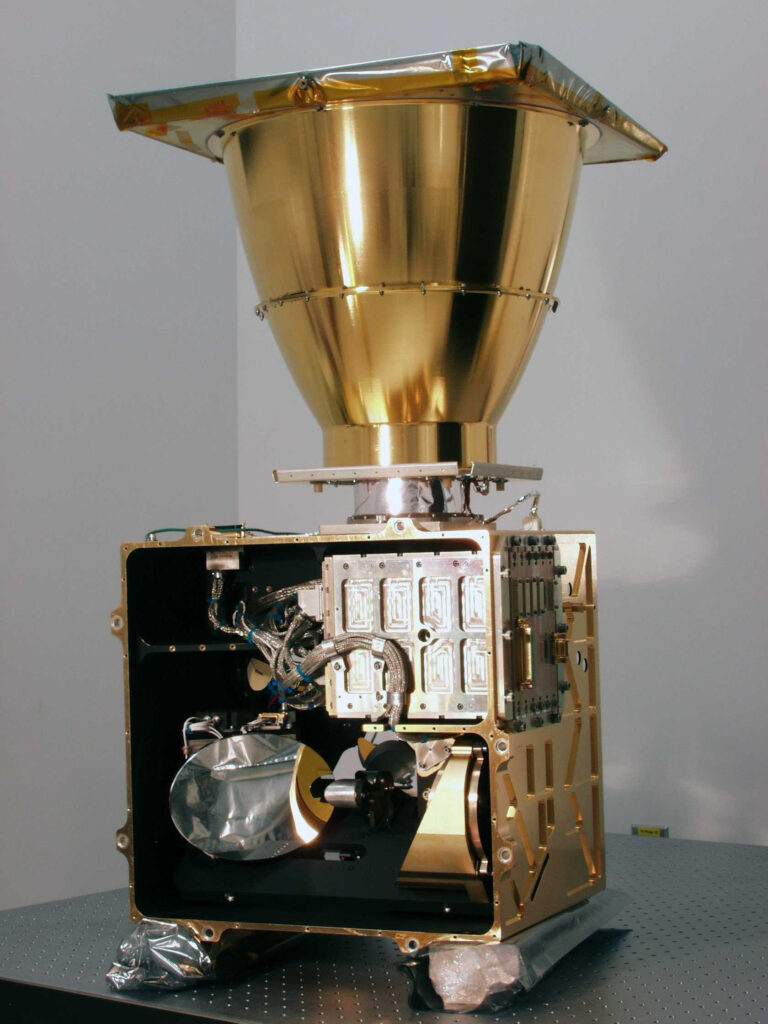
ABB-built infrared Fourier Transform Spectrometer that is the primary payload of Canada's SCISAT-1 satellite, measuring vertical profiles of ozone and dozens of other atmospheric trace gases using the solar occultation technique.
Technical specifications
- Instrument type
- Infrared Fourier Transform Spectrometer (folded double-pass Michelson interferometer) with auxiliary Visible/Near-Infrared Imager
- Spectral range
- 2.2 to 13.3 microns
- Spectral resolution
- 0.02 cm-1 (unapodized)
- Aperture diameter
- 100 mm
- Suntracker pointing stability
- Better than 3 microradians
- Measurement technique
- Solar occultation
- Host satellite
- SCISAT-1 (Canadian Space Agency), 150 kg total mass
- Orbit
- 650 km altitude, 74-degree inclination LEO
- Launch date
- August 12, 2003
- Flight heritage / mission status
- Prime payload of CSA SCISAT-1; still fully operational more than 20 years after launch (2025-2026), far exceeding design life; interferometer design basis for ABB's later GOSAT TANSO-FTS instrument
About
The ACE-FTS (Atmospheric Chemistry Experiment Fourier Transform Spectrometer) is ABB’s flagship space-borne Fourier Transform Spectrometer, designed and manufactured by ABB as prime contractor for the Canadian Space Agency’s SCISAT-1 mission. Launched August 12, 2003 into a 650 km, 74-degree-inclination low Earth orbit, ACE-FTS is the main scientific instrument aboard the small 150 kg SCISAT-1 satellite. It uses the solar occultation technique to derive high-resolution infrared absorption spectra that yield vertical profiles of ozone, chlorine- and nitrogen-containing compounds, greenhouse gases, and dozens of other trace species, with a particular scientific focus on stratospheric/upper-tropospheric ozone chemistry over Canada and the Arctic. The instrument is a highly folded, double-pass adaptation of the classical Michelson interferometer, paired with an auxiliary Visible/Near-Infrared Imager for aerosol extinction measurements and a suntracker providing sub-3-microradian pointing stability. Its design directly informed the interferometer used later in the GOSAT TANSO-FTS greenhouse-gas mission. Flight heritage: sole payload-class instrument on CSA’s SCISAT-1, launched 2003 with a nominal 2-5 year design life; the spacecraft and instrument were still fully operational more than two decades later (as of 2025-2026), far exceeding expectations.
Documentation
Need the full ICD, test reports or a specific revision? Ask the supplier directly.