
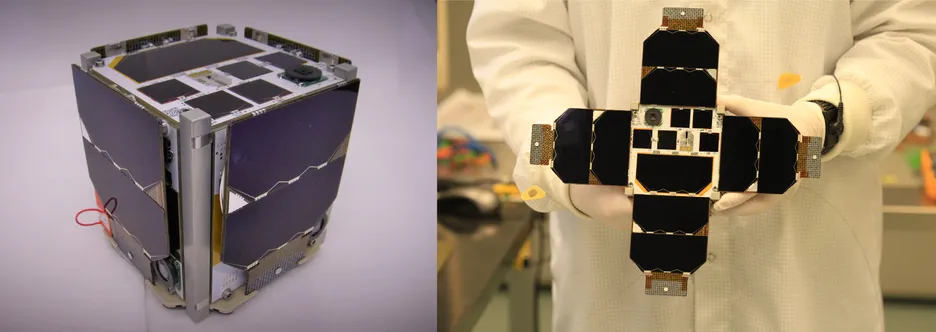
TUM's second student-built CubeSat — 1U nanosatellite launched December 2018, demonstrating atmospheric drag measurement and lithium battery degradation in LEO.
MOVE-II
TUM's second student-built CubeSat — 1U nanosatellite launched December 2018, demonstrating atmospheric drag measurement and lithium battery degradation in LEO.
Description
MOVE-II (Munich Orbital Verification Experiment II) is a 1U CubeSat designed and built by students of the WARR (Wissenschaftliche Arbeitsgemeinschaft für Raketentechnik und Raumfahrt) student group at the Technical University of Munich (TUM). It was launched on December 3, 2018, as part of SSO-A: SmallSat Express mission aboard a SpaceX Falcon 9 into a 575 km sun-synchronous orbit.
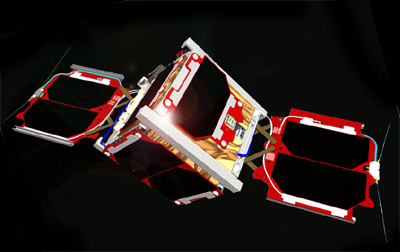
Building on the experience of First-MOVE (launched November 2013), MOVE-II carries two scientific experiments: (1) a drag measurement experiment using a deployable aerodynamic drag augmentation device, designed to characterise upper atmospheric density at LEO altitudes; and (2) a lithium-ion battery degradation experiment measuring capacity fade under radiation and thermal cycling in space, critical for understanding CubeSat power system lifetime. The satellite also carries an onboard computer with an ARM Cortex-M7 processor for autonomous fault management.
MOVE-II achieved full operational status after launch and continues to operate as of 2026. A near-identical twin, MOVE-IIb, was launched in July 2019 on a Soyuz-2.1b from Baikonur to 490 km LEO, enabling direct comparison of orbital decay rates between the two inclinations. The MOVE program has trained over 150 TUM students in satellite engineering, subsystem design, and mission operations, with alumni placing in ESA, DLR, Airbus, and major space startups.
Specifications
| Form factor | 1U CubeSat |
|---|---|
| Mass | ~850 g |
| Dimensions | 10 × 10 × 10 cm |
| Launch date | December 3, 2018 |
| Launch vehicle | SpaceX Falcon 9 (SSO-A: SmallSat Express) |
| Orbit | 575 km sun-synchronous |
| Status (2026) | Operational |
| Payload 1 | Deployable drag augmentation device (atmospheric density) |
| Payload 2 | Li-ion battery degradation experiment |
| OBC | ARM Cortex-M7 |
| Downlink | UHF/VHF amateur |
| Twin satellite | MOVE-IIb (launched July 2019, 490 km LEO) |