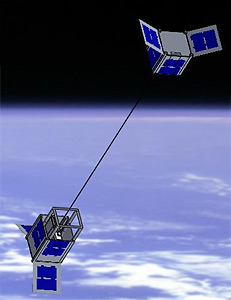

Kagawa University / Kyoto University Mother-Daughter tethered satellite — 100-metre Kevlar-copper tether deployed from ISS January 2017, demonstrating space tether deployment for electrodynamic propulsion.
STARS-C (Space Tethered Autonomous Robotic Satellite C)
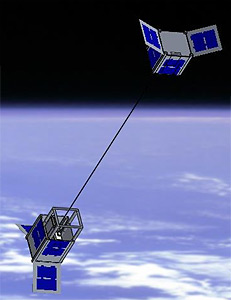
Kagawa University / Kyoto University Mother-Daughter tethered satellite — 100-metre Kevlar-copper tether deployed from ISS January 2017, demonstrating space tether deployment for electrodynamic propulsion.
Description
STARS-C (Space Tethered Autonomous Robotic Satellite C) is a tethered double-CubeSat system developed primarily by Kagawa University in collaboration with Kyoto University. It was built as the third satellite in the STARS programme — following KUKAI (Kyoto, 2009) and STARS-II (Kyoto/Shizuoka, 2014) — with a focus on advancing space tether deployment reliability.
STARS-C was launched on December 9, 2016, aboard HTV-6 (Kounotori 6) from the Tanegashima Space Center and delivered to the International Space Station. It was deployed from the ISS Japanese Experiment Module (Kibo) via J-SSOD on January 16, 2017. The system consists of a Mother CubeSat (2U) and a Daughter CubeSat (1U) connected by a 100-metre Kevlar/copper composite tether. After deployment, the separation mechanism activated and the tether began to unspool.
STARS-C successfully deployed the tether — a significant improvement over STARS-II's partial deployment. The copper component of the tether enables electrodynamic interaction with Earth's magnetic field when carrying an electric current, generating a braking or boosting force without propellant. This technology has applications in propellant-free orbital maneuvering, active deorbit of spent stages, and momentum exchange for transferring smallsats between orbits.
The project was led by Professor Hirohisa Kojima at Kagawa University's Department of Intelligent Mechanical Systems Engineering, with support from JAXA's small satellite programme. STARS-C demonstrated that even small regional universities can lead impactful space technology missions.
Specifications
| Configuration | Mother (2U) + Daughter (1U) CubeSat pair |
|---|---|
| Tether | 100 m Kevlar/copper composite |
| Launch | December 9, 2016 (HTV-6 Kounotori 6) |
| Deployment from ISS | January 16, 2017 (Kibo J-SSOD) |
| Tether deployment | Successful |
| Tether function | Electrodynamic (copper conductor in Earth's magnetic field) |
| Partners | Kagawa University (lead), Kyoto University |
| Lead PI | Prof. Hirohisa Kojima, Kagawa University |
| Programme | STARS series (successor to STARS-II) |