

OTB is a flexible, modular, low-cost hosted-payload smallsat platform built by General Atomics Electromagnetic Systems to launch and operate multiple technology-demonstration payloads simultaneously on a single spacecraft.
Orbital Test Bed (OTB) Satellite
OTB is a flexible, modular, low-cost hosted-payload smallsat platform built by General Atomics Electromagnetic Systems to launch and operate multiple technology-demonstration payloads simultaneously on a single spacecraft.
Description
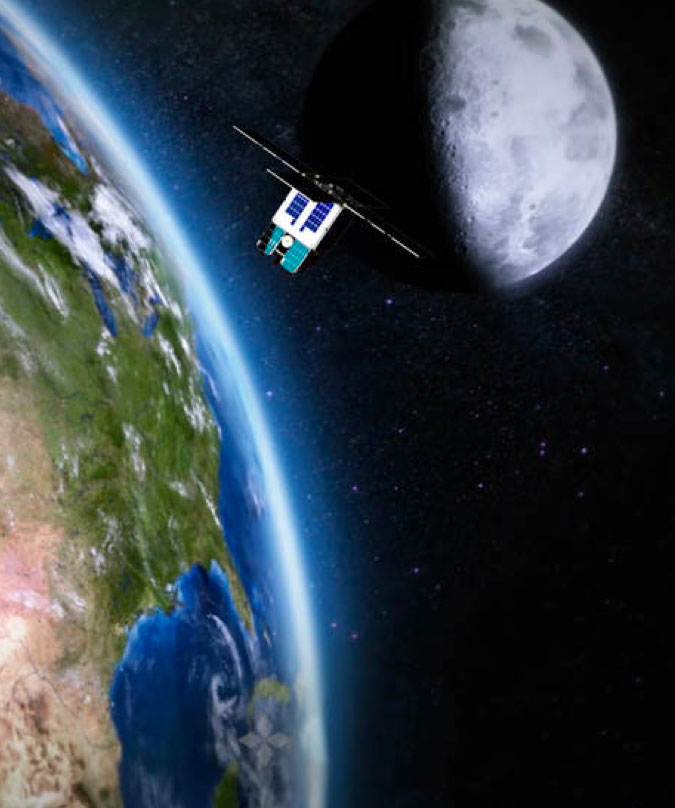
The Orbital Test Bed satellite, built by General Atomics Electromagnetic Systems, offers an innovative, cost-efficient design for the simultaneous launch of multiple demonstration payloads to validate new space technologies on-orbit. The platform features a flexible, modular, and scalable architecture optimized for high-performance missions in Low Earth Orbit and a broad range of payload types, enabling government, commercial, and academic customers to space-qualify new technology and gain flight heritage without procuring a costly dedicated launch. The first OTB satellite launched in June 2019 aboard a SpaceX Falcon Heavy rocket as part of the U.S. Air Force Space Technology Program (STP-2) mission from Kennedy Space Center, riding on an ESPA ring adapter into a 720 km circular orbit at 24° inclination. OTB-1 hosted several payloads including NASA JPL's Deep Space Atomic Clock, an AFRL-developed Modular Solar Array, the U.S. Air Force Academy's Integrated Miniaturized Electrostatic Analyzer, the RadMon radiation effects monitor, and the FlexRX programmable satellite receiver. OTB-1 successfully completed its scheduled five-year mission and began its estimated two-decade deorbit phase. GA-EMS has since expanded the platform concept into its GA-75, GA-150, and GA-500 configurable ESPA-class satellite bus family for LEO through cislunar and xGEO missions.
Specifications
| Mass | 139 kg |
|---|---|
| Dimensions (stowed) | 609 x 629 x 980 mm |
| Dimensions (deployed) | 1442 x 2462 x 975 mm |
| Orbit average power | 150 W |
| Orbit | 720 km circular altitude, 24° inclination |
| Launch date | June 25, 2019, U.S. Air Force STP-2 mission, SpaceX Falcon Heavy |
| Payload adapter | ESPA ring |
| Hosted payloads | Deep Space Atomic Clock, Modular Solar Array, iMESA-R, RadMon, FlexRX programmable receiver, Celestis memorial payloads |
| Flight heritage | OTB-1 launched June 2019; completed full scheduled five-year mission in 2024 and entered an estimated two-decade deorbit phase |