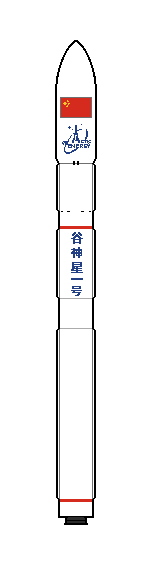

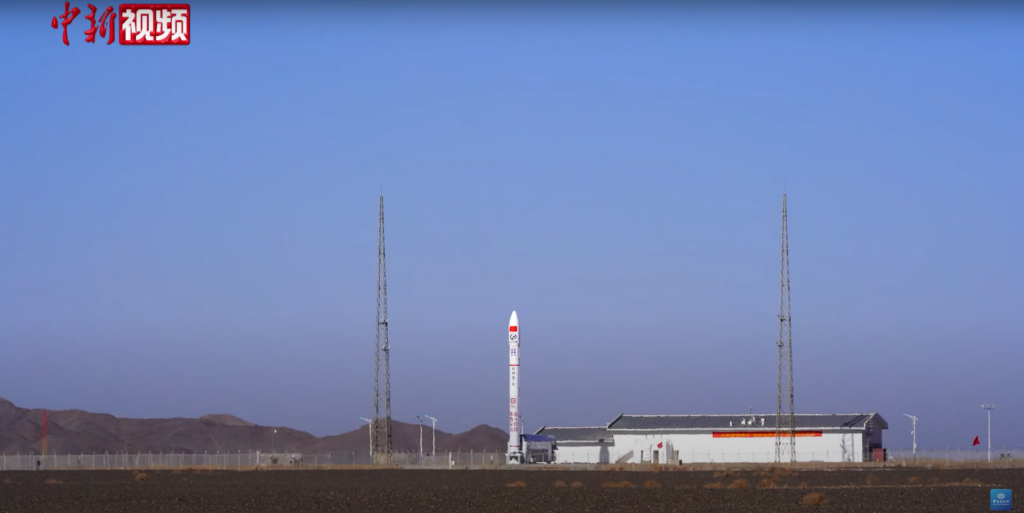
Ceres-1 is a four-stage, small solid-propellant orbital launch vehicle developed by the private Chinese company Galactic Energy, operational since its debut flight in November 2020.
Ceres-1
Ceres-1 is a four-stage, small solid-propellant orbital launch vehicle developed by the private Chinese company Galactic Energy, operational since its debut flight in November 2020.

Description
Ceres-1 is a four-stage commercial small-satellite launch vehicle independently designed and manufactured by Galactic Energy. The first three stages use solid-propellant rocket motors (GS-1, GS-2, GS-3) providing high launch readiness, low cost, and quick turnaround, while the fourth stage uses a liquid (hydrazine) propulsion system for precise orbital insertion. The vehicle stands about 20 m tall with a 1.4 m body diameter and a liftoff mass of roughly 33,000 kg, delivering up to 400 kg to low Earth orbit or about 300 kg to a 500 km Sun-synchronous orbit. It targets the commercial small-satellite launch market at a cost of roughly $4.5 million per launch. Ceres-1 made its maiden flight on 7 November 2020, becoming the first orbital launch by a Chinese private company using an all-solid rocket. Since then it has flown over 20 missions with a strong success record, deploying Jilin-1 Earth-observation satellites, Tianqi IoT constellation satellites, and other commercial smallsats. A sea-launched variant, Ceres-1S, debuted on 5 September 2023, adding flexible launch-site selection.
Specifications
| Height | ~20 m |
|---|---|
| Diameter | 1.4 m |
| Liftoff mass | ~33,000 kg |
| Stages | 4 (three solid stages + one liquid/hydrazine upper stage) |
| Propulsion | Stages 1-3: solid propellant (GS-1/GS-2/GS-3); Stage 4: liquid hydrazine |
| Payload to LEO | 400 kg |
| Payload to SSO (500 km) | 300 kg |
| Cost per launch | ~$4.5 million |
| Flight heritage | First flight 7 November 2020; over 20 launches to date with a large majority successful; includes the sea-launched Ceres-1S variant, first flown 5 September 2023 |