

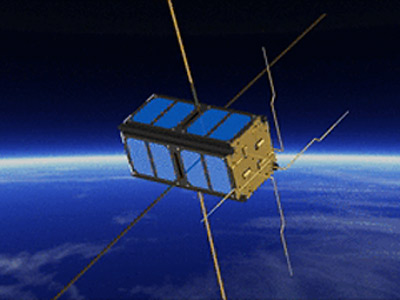
FH Wiener Neustadt 1U CubeSat in QB50 constellation — Passive Experiment Gaining Astrodynamic University Satellite, launched February 2017 via PSLV for thermosphere research.
PEGASUS
FH Wiener Neustadt 1U CubeSat in QB50 constellation — Passive Experiment Gaining Astrodynamic University Satellite, launched February 2017 via PSLV for thermosphere research.
Description
PEGASUS (Passive Experiment Gaining Astrodynamic University Satellite) is a 1U CubeSat (10×10×10 cm) developed by students at FH Wiener Neustadt (University of Applied Sciences Wiener Neustadt) as Austria's contribution to the international QB50 programme. QB50 was a coordinated constellation of 50 CubeSats organised by the von Karman Institute for Fluid Dynamics (Belgium) and supported by the European Commission, with the goal of studying the poorly characterised lower thermosphere between 200 and 380 km altitude.
PEGASUS was launched on February 15, 2017 aboard India's PSLV-C37 rocket from Sriharikota, which simultaneously deployed a world-record 104 satellites — PEGASUS among them — into a 506 km sun-synchronous orbit. This PSLV mission was a landmark event in the history of small satellite launches.
PEGASUS carried the Multi-Needle Langmuir Probe (m-NLP) instrument developed at the University of Oslo as its primary scientific payload, designed to measure electron density and temperature in the ionospheric plasma. It also carried an onboard computer for attitude determination (using magnetometers and sun sensors) and UHF radio communications. The satellite was built under ESA's Fly Your Satellite educational programme, providing access to qualification testing at ESA's ESTEC facility (Netherlands) and mission support from ESA engineers.
PEGASUS operated for approximately 12 months before orbital decay, returning scientific data on ionospheric electron density profiles and validating the FH Wiener Neustadt space engineering programme as a serious CubeSat developer.
Specifications
| Form factor | 1U CubeSat |
|---|---|
| Mass | ~1 kg |
| Launch date | February 15, 2017 |
| Launch vehicle | PSLV-C37 (India, 104-satellite record launch) |
| Orbit | 506 km sun-synchronous |
| Programme | QB50 lower thermosphere research constellation |
| Primary payload | Multi-Needle Langmuir Probe (m-NLP) — ionospheric electron density |
| ESA programme | Fly Your Satellite |
| Mission duration | ~12 months (natural decay) |