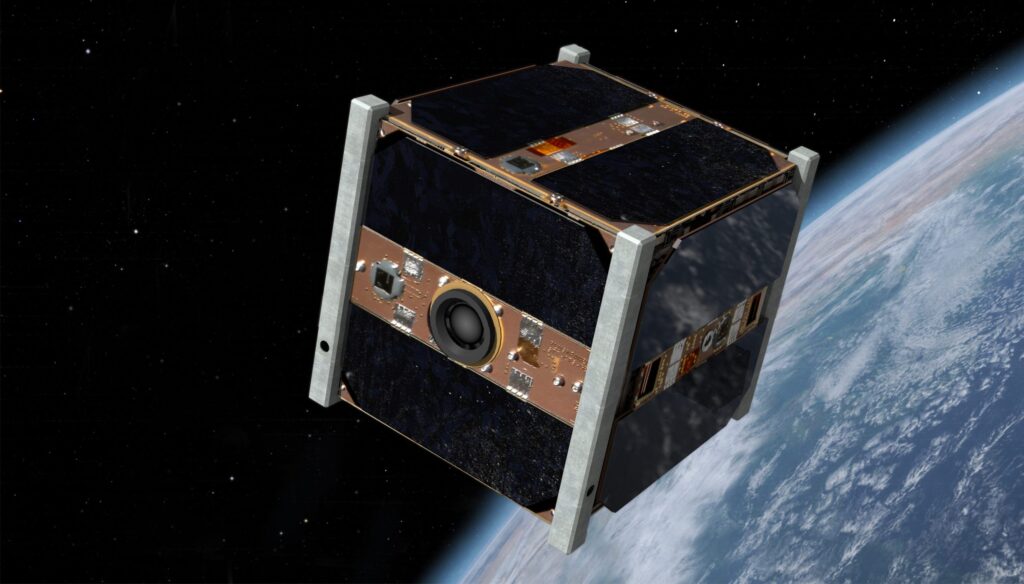
Switzerland's first satellite — 1U CubeSat measuring atmospheric airglow, launched September 2009, operational for over a decade.
SwissCube
Switzerland's first satellite — 1U CubeSat measuring atmospheric airglow, launched September 2009, operational for over a decade.
Description
SwissCube is a 1U CubeSat (10×10×10 cm, 820 g) developed entirely by students at the École Polytechnique Fédérale de Lausanne (EPFL) under the supervision of EPFL's Space Center (eSpace). It was Switzerland's first satellite and the first CubeSat developed by a Swiss institution.
Designed and built over five years by more than 200 students from 11 EPFL sections, SwissCube was launched on September 23, 2009, aboard India's PSLV-C14 rocket into a 720 km sun-synchronous orbit. The primary scientific mission was to image the Earth's nightglow — specifically the airglow produced at 762 nm by oxygen recombination in the mesosphere at 90 km altitude, a phenomenon related to atmospheric chemistry and climate. The payload was a single-band CCD camera with a focusing lens optimised for the nightglow wavelength.
SwissCube far exceeded its one-year design life and remained operational for over 12 years, becoming one of the longest-lived 1U CubeSats and a benchmark for educational satellite programs globally. It was tracked regularly by amateur radio operators worldwide (call sign HB9EGO) and demonstrated full two-way UHF communication with a ground station at EPFL. The mission validated the concept of a university-class satellite designed, built, tested, and operated entirely in-house, inspiring subsequent Swiss space programs.
Specifications
| Form factor | 1U CubeSat |
|---|---|
| Mass | 820 g |
| Dimensions | 10 × 10 × 10 cm |
| Launch date | September 23, 2009 |
| Launch vehicle | PSLV-C14 (ISRO) |
| Orbit | 720 km sun-synchronous |
| Design life | 1 year (operated >12 years) |
| Primary payload | Single-band CCD camera (762 nm nightglow) |
| Downlink | UHF amateur radio (HB9EGO) |
| Ground station | EPFL campus, Lausanne |
| Team | >200 students from 11 EPFL sections |