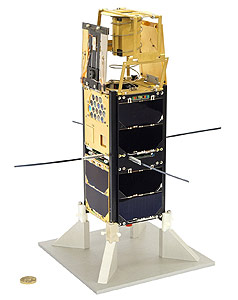
Czech Republic's 2U CubeSat in QB50 — carried miniaturised coded-aperture X-ray telescope and radiation monitor, launched June 2017 via PSLV.
VZLUSAT-1
Czech Republic's 2U CubeSat in QB50 — carried miniaturised coded-aperture X-ray telescope and radiation monitor, launched June 2017 via PSLV.
Description
VZLUSAT-1 is a 2U CubeSat (10×10×20 cm) developed by the Czech Aerospace Research Centre (VZLU) with the Czech Technical University in Prague (CTU/ČVUT) as an institutional partner, as part of the international QB50 thermosphere research programme. It was launched on June 23, 2017, aboard India's PSLV-C38 rocket into a 505 km sun-synchronous orbit alongside 30 other international satellites.
VZLUSAT-1 carried one of the most sophisticated payloads in the QB50 constellation: a miniaturised coded-aperture X-ray telescope (SATIX), designed to image the Sun and bright X-ray sources using a tungsten mask aperture projected onto a silicon photomultiplier detector array. This instrument, developed by VZLU and the Czech Academy of Sciences, was a pathfinder for compact space X-ray astronomy instruments. A secondary payload — the FIPEX instrument from TU Dresden — measured atomic oxygen concentrations in the lower thermosphere, consistent with the QB50 scientific mission.
VZLUSAT-1 operated successfully, returning scientific data on X-ray sources and thermospheric composition. The satellite re-entered the atmosphere in 2019 following natural orbital decay. The CTU contributed to the OBC, attitude determination system, and communications subsystem, with students gaining hands-on experience in space-grade electronics design, testing, and operations.
The follow-on VZLUSAT-2 (3U CubeSat) was launched on SpaceX Falcon 9 Transporter-3 in January 2022, with CTU's Faculty of Electrical Engineering contributing more advanced subsystems for the next-generation Czech nanosatellite.
Specifications
| Form factor | 2U CubeSat |
|---|---|
| Mass | ~2 kg |
| Launch date | June 23, 2017 |
| Launch vehicle | PSLV-C38 (India) |
| Orbit | 505 km sun-synchronous |
| Primary payload | SATIX miniaturised coded-aperture X-ray telescope |
| Secondary payload | FIPEX atomic oxygen sensor (TU Dresden) |
| Programme | QB50 lower thermosphere constellation |
| Lead | Czech Aerospace Research Centre (VZLU) |
| Partner | Czech Technical University in Prague (CTU) |
| Mission duration | ~2 years (re-entered 2019) |
| Successor | VZLUSAT-2 (3U, SpaceX Transporter-3, January 2022) |