
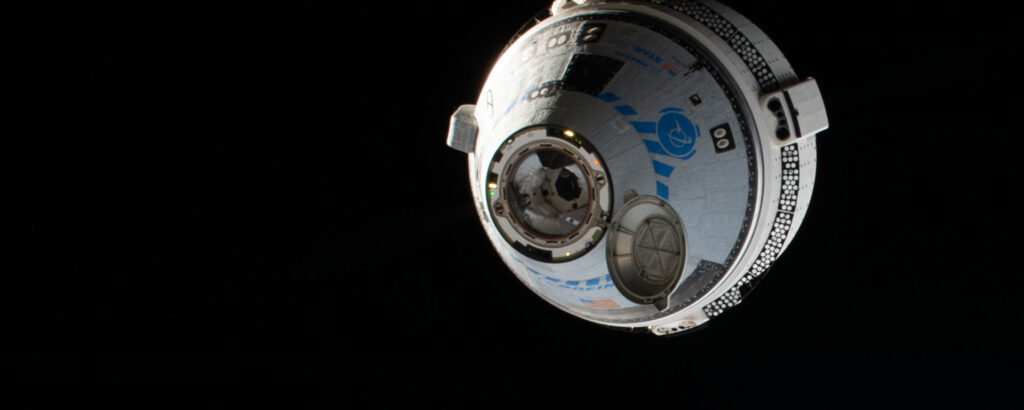
Boeing's CST-100 Starliner is a partially reusable crew capsule built for NASA's Commercial Crew Program to ferry astronauts and cargo to and from the International Space Station.
CST-100 Starliner
Boeing's CST-100 Starliner is a partially reusable crew capsule built for NASA's Commercial Crew Program to ferry astronauts and cargo to and from the International Space Station.
Description
The CST-100 Starliner is Boeing's crew capsule developed with NASA under the Commercial Crew Program to transport astronauts and cargo to low Earth orbit, primarily the International Space Station. The weldless, gumdrop-shaped spacecraft can carry up to seven passengers, is designed for up to 10 reuses of its crew module, and launches atop a United Launch Alliance Atlas V rocket (with Vulcan Centaur planned for future flights). It is a fully autonomous, self-flying spacecraft capable of independently docking with and undocking from the ISS, and is the first American orbital capsule designed to land on solid ground rather than splash down at sea. Starliner's flight history has been troubled: an uncrewed Orbital Flight Test (OFT-1) in December 2019 suffered a software timer error that prevented it from reaching the ISS; a repeat uncrewed test, OFT-2, finally reached and docked with the station in May 2022. Its Crew Flight Test launched in June 2024 with NASA astronauts Butch Wilmore and Suni Williams, but encountered helium leaks and multiple reaction control thruster failures; NASA opted to return Starliner uncrewed in September 2024 while the astronauts returned via a SpaceX Crew Dragon in March 2025. As of mid-2026, Starliner has not yet been certified for operational crewed flights: NASA and Boeing revised the contract so the next mission, Starliner-1, will fly uncrewed and cargo-only, targeted for no earlier than April 2026, with NASA's Office of Inspector General indicating routine crewed certification may not occur until 2027 at the earliest.
Specifications
| Crew capacity | Up to 7 passengers |
|---|---|
| Height | 16.5 ft (5 m) |
| Diameter | 15 ft (4.6 m) |
| Weight | 14,690 lb (6,663 kg) |
| Reusability | Crew module designed for up to 10 flights |
| Launch vehicle | United Launch Alliance Atlas V (Vulcan Centaur planned for future missions) |
| Landing method | Airbag-cushioned ground landing in the western United States |
| Flight mode | Fully autonomous self-flying spacecraft; independent ISS docking/undocking capability |
| Flight heritage/status (mid-2026) | OFT-1 (Dec 2019) failure; OFT-2 (May 2022) success; CFT (Jun 2024) - helium leaks and thruster failures, astronauts returned via SpaceX Dragon (Mar 2025); next mission Starliner-1 uncrewed/cargo-only, NET April 2026; routine crewed certification not expected before 2027 |