
LEOS-50 is Berlin Space Technologies' flight-proven small satellite bus, purpose-built for demanding Earth observation missions with medium-sized payloads up to 30 kg.
LEOS-50
LEOS-50 is Berlin Space Technologies' flight-proven small satellite bus, purpose-built for demanding Earth observation missions with medium-sized payloads up to 30 kg.
Description
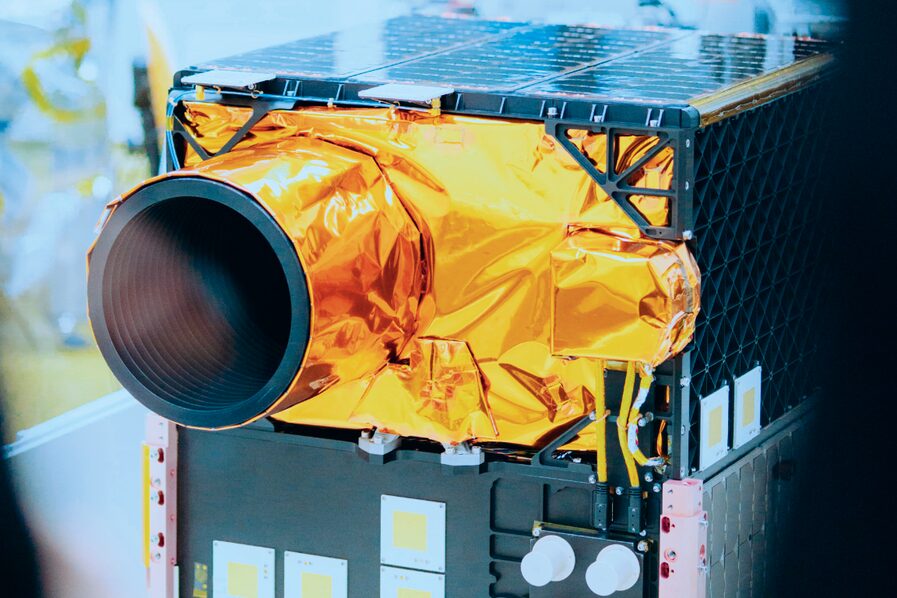
The LEOS-50 is Berlin Space Technologies' heritage small satellite platform, flight proven with in-orbit operation since 2015. It is designed for demanding Earth observation missions carrying medium-sized payloads, offering a payload envelope of up to 55 x 55 x 40 cm and up to 30 kg payload mass. The bus provides up to 160 W peak payload power, a high-speed 10 Gbps payload data interface with 1 TB onboard storage, and an X-band downlink of up to 100 Mbps, with CCSDS-compatible communications including authentication and encryption. It supports electrical propulsion and is designed for a 5-year LEO mission life, targeting government space agencies, New Space operators, and commercial Earth observation customers. Flight heritage includes NExSat-1, an Egyptian Earth-observation microsatellite built with Egypt's National Authority of Space Sciences, launched February 2024; and AFR (ABA First Runner), an 80 kg Indian Earth-observation nanosatellite built by Azista BST Aerospace, launched June 2023 on a Falcon 9 rideshare. BST also offers the related, more powerful LEOS-100 platform built on LEOS-50's flight-proven avionics for payloads up to 250 kg.
Specifications
| Max payload mass | 30 kg |
|---|---|
| Payload envelope | 55 x 55 x 40 cm |
| Peak payload power | 160 W |
| Payload data rate | 10 Gbps |
| Onboard storage | 1 TB per data processing unit |
| Downlink | X-band, up to 100 Mbps |
| Communications security | CCSDS-compatible with authentication and encryption |
| Propulsion | Electrical propulsion |
| Design lifetime | 5 years (LEO) |
| Flight heritage | In-orbit since 2015; missions include NExSat-1 (Egypt, launched Feb 2024) and AFR/ABA First Runner (India, launched Jun 2023) |