
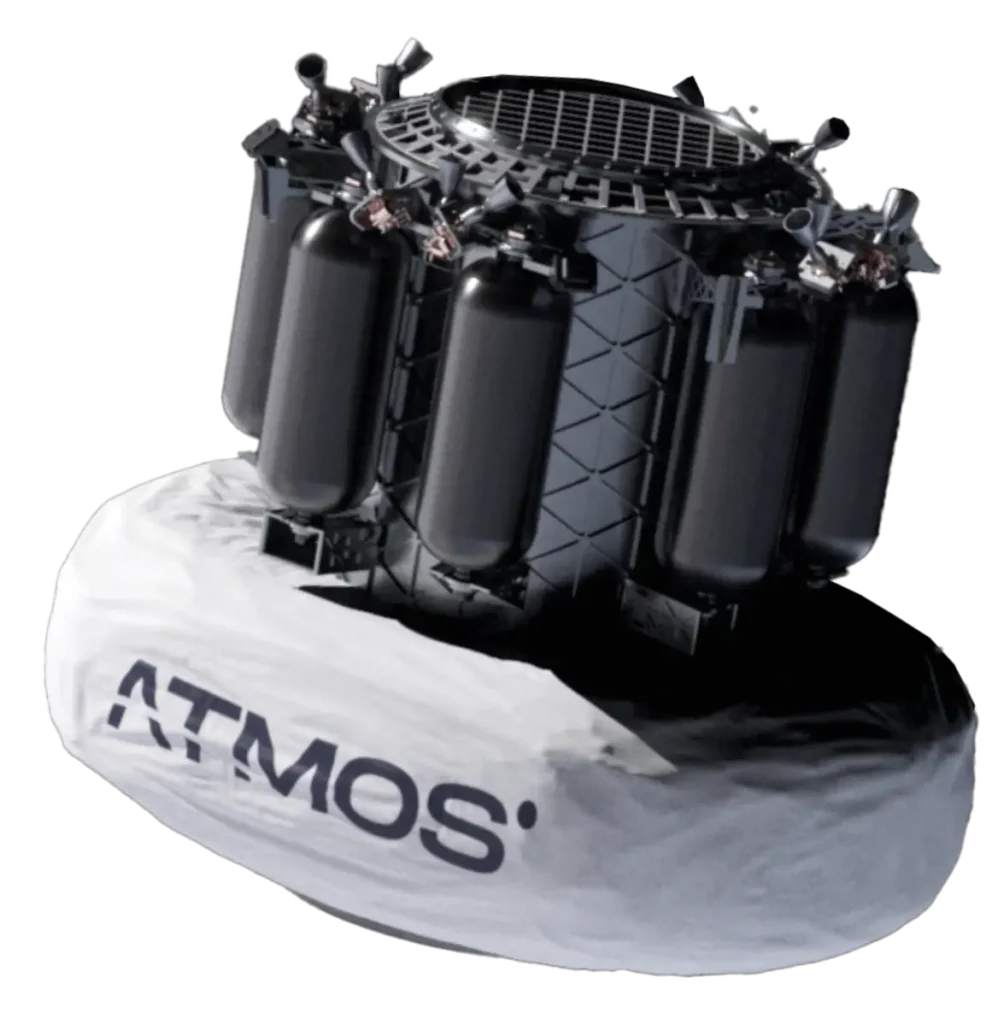
PHOENIX 2 is a reusable Orbital Transfer and Return Vehicle (OTRV) that enables autonomous cargo operations in Low Earth Orbit with controlled precision re-entry and rapid payload recovery.
PHOENIX 2
PHOENIX 2 is a reusable Orbital Transfer and Return Vehicle (OTRV) that enables autonomous cargo operations in Low Earth Orbit with controlled precision re-entry and rapid payload recovery.
Description
PHOENIX 2 is ATMOS Space Cargo's flagship reusable Orbital Transfer and Return Vehicle (OTRV), designed to transform space logistics into a circular, repeatable infrastructure. The vehicle operates autonomously in Low Earth Orbit for durations ranging from 3 hours to 12 months, supporting a wide range of missions including life sciences research, in-space manufacturing, and defense applications. Its pressurized payload compartment maintains a 1 atm environment with thermal control between 4–40°C, providing a shirt-sleeve environment for sensitive payloads.
The PHOENIX 2 carries up to 100 kg of payload and accommodates experiment form factors including 1U–3U CubeSat standards, ISS middeck locker equivalents, and custom configurations. Onboard power delivery provides 50W mean and 100W peak via unregulated 28V or regulated 5V, 12V, and 24V rails, with data interfaces via Ethernet and Serial. Microgravity levels below 10⁻⁵ g are maintained throughout orbital operations.
Controlled re-entry is enabled by an integrated Inflatable Atmospheric Decelerator (IAD), a non-ablative heat shield and aerodynamic brake that provides precision landing accuracy up to 10× higher than conventional parachute-based systems. Recovery operations are centered near Santa Maria in the Azores, Portugal, leveraging ATMOS's first-of-its-kind commercial re-entry license in Portugal. Seven PHOENIX missions are scheduled for 2026–2028, launching on SpaceX Falcon 9 rideshare missions.
ATMOS provides end-to-end mission services with PHOENIX 2, including payload integration and qualification (AIT) at their facilities, logistics and launcher integration, in-orbit mission control, data downlink and monitoring, and controlled re-entry with payload retrieval and return to a customer-selected general aviation airport.
Specifications
| Payload Capacity | 100 kg |
|---|---|
| Flight Duration | 3 hours to 12 months (selectable) |
| Payload Compartment Pressure | 1 atm (pressurized) |
| Payload Temperature Range | 4–40°C |
| Microgravity Level | < 10⁻⁵ g |
| Power (Mean) | 50 W |
| Power (Peak) | 100 W |
| Power Rails | 28V unregulated; 5V, 12V, 24V regulated |
| Data Interfaces | Ethernet and Serial |
| Payload Form Factors | 1U–3U, ISS middeck locker, or custom |
| Landing Accuracy | Up to 10× higher than parachute-based systems |
| Recovery Location | Santa Maria, Azores, Portugal |
| Launch Vehicle | SpaceX Falcon 9 (rideshare) |
| Vehicle Type | Reusable Orbital Transfer and Return Vehicle (OTRV) |
| Re-entry System | Inflatable Atmospheric Decelerator (IAD), non-ablative |