
Odin was AstroForge's first commercial deep-space asteroid-prospecting spacecraft, launched in February 2025 to fly by and image the metallic near-Earth asteroid 2022 OB5, but contact with the probe was lost days after launch.
Odin
Odin was AstroForge's first commercial deep-space asteroid-prospecting spacecraft, launched in February 2025 to fly by and image the metallic near-Earth asteroid 2022 OB5, but contact with the probe was lost days after launch.
Description
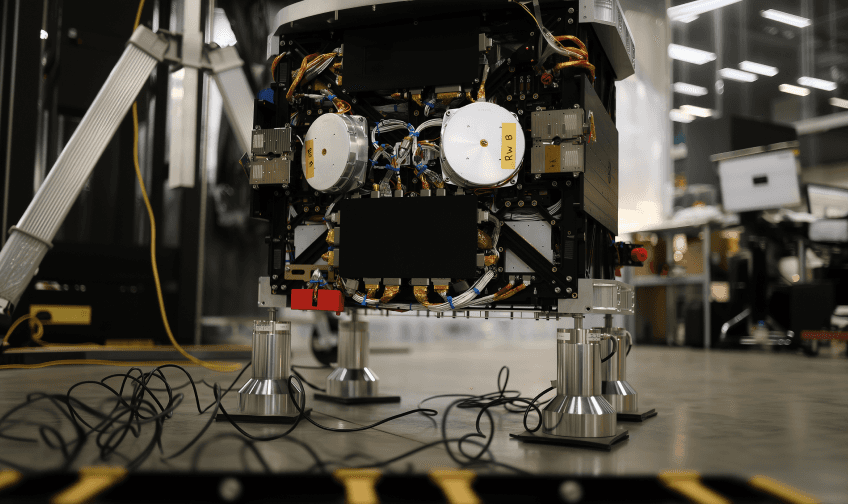
Odin was AstroForge's inaugural deep-space mission, built to become the first privately funded spacecraft to travel beyond the Moon on a commercial asteroid-prospecting mission. Built on a ~105 kg satellite bus supplied by OrbAstro in under 10 months for roughly $3.5 million, Odin carried multispectral/monochromatic cameras intended to image and characterize the near-Earth metallic asteroid 2022 OB5 during a planned flyby, gathering data to assess the asteroid's suitability for future resource extraction. Odin launched on February 26, 2025 as a rideshare payload aboard the SpaceX Falcon 9 carrying Intuitive Machines' IM-2 lunar lander mission, becoming the first privately developed spacecraft to travel past the Moon into deep space. Shortly after separation, the spacecraft experienced severe communication and ground-station problems; only sporadic signals were received in the days following launch, with the spacecraft appearing to be tumbling. AstroForge officially declared the mission lost on March 6, 2025, roughly a week after launch, having traveled about 300,000 km. As of mid-2026, Odin has not been recovered; AstroForge has since applied lessons learned to its successor, DeepSpace-2, a 200 kg spacecraft slated to launch in Q4 2026 to attempt a rendezvous with the same target asteroid.
Specifications
| Spacecraft mass | ~105 kg |
|---|---|
| Mission type | Deep-space flyby and imaging mission |
| Bus manufacturer | OrbAstro |
| Development time | Built in under 10 months |
| Program cost | ~$3.5 million |
| Target asteroid | 2022 OB5 (near-Earth metallic asteroid) |
| Launch date | February 26, 2025 |
| Launch vehicle | SpaceX Falcon 9, rideshare with Intuitive Machines IM-2 lunar lander mission |
| Mission outcome | Contact lost days after launch; mission declared lost March 6, 2025 due to communications/ground-station failures and suspected tumbling |
| Predecessor | Brokkr-1 (6U CubeSat, launched April 2023, also lost due to communication failure) |
| Successor | DeepSpace-2 (200 kg spacecraft), planned launch Q4 2026 to same target asteroid |